
Secret Santa · Game variation
Secret Santa dice game: rules that work at the table
In a Secret Santa dice game, no one draws a name ahead of time. All the gifts go in the middle, and each roll tells you whether to take, swap, or pass a gift. There are three common rule sets — and you can compare all three here.
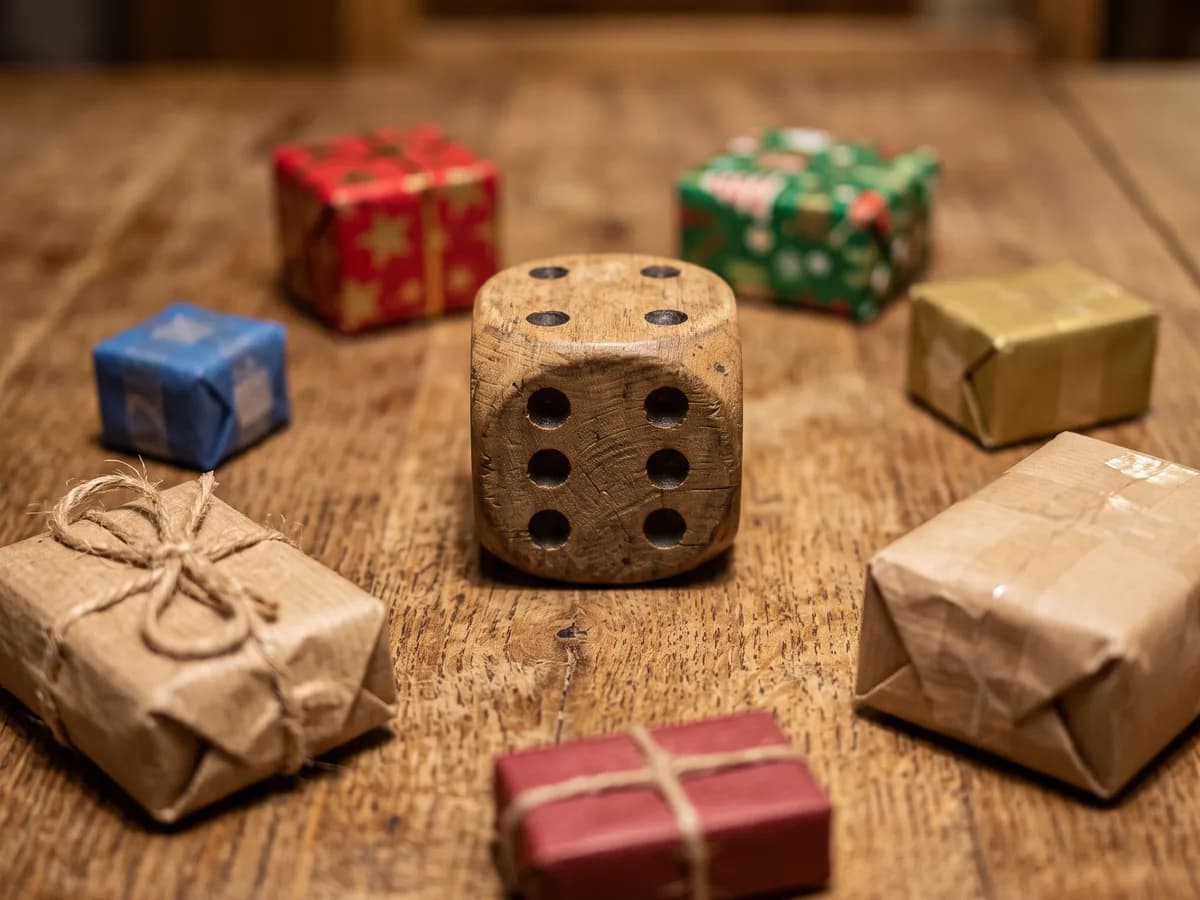
How it works
- Everyone brings one wrapped gift
Use the same spending limit for everyone. No one draws a recipient beforehand — that is what makes this different from classic Secret Santa. For a no-spend version, make it a White Elephant exchange.
- Put every gift in the middle
Keep the gifts anonymous and within everyone’s reach. For a large group, two smaller piles work better than one.
- Choose one rule set — out loud and before you start
This is the step groups usually skip. If two people discover on the third roll that they learned different rules, the game turns into a debate.
- Take turns rolling
Go clockwise, with one roll per person in each round. The number rolled determines what happens.
- Stop after a set amount of time
Ten to fifteen minutes is enough. Without an end point, people keep rolling until the fun is gone; then unwrap the remaining gifts together.
Compare the three rule sets
Online guides use at least three different meanings for each number on the die, and rarely mention that the rules vary. That is exactly how confusion starts at the table.
On a narrow screen, the table shows only the selected rule set. Wider screens show all three side by side.
| Roll | Version A — Swap | Version B — Take and unwrapRecommended | Version C — Quick version |
|---|---|---|---|
| 1 | swap with the person on your left | unwrap your gift | choose one gift from the pile |
| 2 | swap with the person on your right | swap gifts | swap gifts |
| 3 | swap with anyone | everyone passes left | everyone passes left |
| 4 | everyone passes left | everyone passes right | — |
| 5 | everyone passes right | the people on your left and right swap | everyone passes right |
| 6 | make two other people swap | take one gift from the middle | unwrap your gift |
Version A is the one most often found in general guides, Version B is common in White Elephant-style games, and Version C is a shorter option with no action for rolling a four. All three work — but use only one per game.
Our recommendation
It has one advantage the others do not: Every roll produces an action everyone can see. In Version A, rolling a six makes two other people swap while the person who rolled watches. That slows the game down.
Two house rules make the game run better:
- Do not unwrap until the second round. Otherwise every gift may be open after the first pass and the suspense disappears.
- Limit each gift to two swaps. Without a limit, the same package can circle the table all night.
Roll here
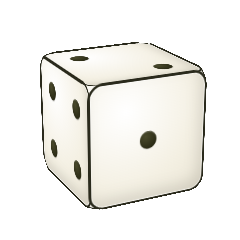
No die handy? This one is all you need, and it sits beside the rules so no one has to search for another tool.
Version A — SwapVersion B — Take and unwrap (recommended)Version C — Quick version
- Roll 1: swap with the person on your left
- Roll 2: swap with the person on your right
- Roll 3: swap with anyone
- Roll 4: everyone passes left
- Roll 5: everyone passes right
- Roll 6: make two other people swap
- Roll 1: unwrap your gift
- Roll 2: swap gifts
- Roll 3: everyone passes left
- Roll 4: everyone passes right
- Roll 5: the people on your left and right swap
- Roll 6: take one gift from the middle
- Roll 1: choose one gift from the pile
- Roll 2: swap gifts
- Roll 3: everyone passes left
- Roll 4: —
- Roll 5: everyone passes right
- Roll 6: unwrap your gift
More free printables
Steal-a-gift: the version where gifts can be taken
Steal-a-gift needs no die, but the idea is related: gifts still move around, except turn order rather than chance controls the game.
How to play: The youngest player starts, chooses a gift from the pile, and unwraps it for everyone to see. The next player may open a new gift or steal an opened one. Anyone whose gift is stolen takes the next turn immediately and gets the same choice.
The house rule the game needs: A gift may be stolen no more than twice; after that, it is locked. Otherwise one popular gift can circulate forever while everyone else loses interest.
The game works because everyone can see what is available. With more than fifteen people, it drags; the dice version is a better choice for a group that large.
Ad
If you want a real die
A large die is easier to share at the table than a phone, especially in a bigger group where everyone wants to see the result at once.
Product box with one to three suggestions and one-line reasons. We may earn a commission from qualifying purchases.
Frequently asked questions
What does each number mean?
It depends on the rule set, which is the source of the confusion. The table compares three versions; we recommend Version B.
Do you need one die or two?
One. Two dice create eleven possible totals that would each need a rule, and no one wants to memorize all of them.
How long should the game last?
Ten to fifteen minutes. Set a time or number of rounds before starting so the game ends while it is still fun.
When do you unwrap the gifts?
In Version B, a one means unwrap, but only from the second round onward. Opening gifts immediately removes the suspense.
Can children play?
Yes, and it can work better than classic Secret Santa because children do not have to keep a secret for weeks. For younger children, assign actions to only three numbers.
What if someone did not bring a gift?
They can still roll, but they receive a gift only after everyone who brought one has one. State that rule before the game rather than deciding mid-round.
Is a Secret Santa dice game the same as White Elephant?
No. White Elephant describes the type of gifts or shared-pool exchange, while the dice game describes how gifts move. The two can be combined.