
Secret Santa · Overview
Secret Santa: Rules, Ideas, and Every Variation
In Secret Santa, everyone in the group is secretly assigned one other person to buy a gift for. The group agrees on one spending limit in advance, and each match stays hidden until the gift exchange.

Secret Santa in one sentence
Secret Santa is a gift exchange in which everyone buys for exactly one person—and does not know who is buying for them.
The tradition is known as Julklapp in northern Germany and Scandinavia, Secret Santa in English-speaking countries, and amigo secreto in Portugal. The basic idea is the same in each case.
Do not confuse it with an elf door: in that December tradition, an invisible elf moves in behind a tiny door and leaves children letters and pranks. It is a separate custom, not a gift exchange.
How it works
- Choose the group
Put everyone who wants to participate into the draw—it works with three or more people.
Ask first; do not simply add people. Anyone who would rather not join should be able to say so before names are drawn.
- Set the budget
$5 to $20 is typical, and the same limit applies to everyone.
Give both a minimum and a maximum. One person may read “around $10” as $4 while another reads it as $25.
- Draw names
Everyone draws someone else, and no one draws themselves.
Self-draws happen all the time with slips in a hat—and anyone who redraws learns more than everyone else. An online draw handles the assignments cleanly in ten seconds.
- Buy the gift
Keep it within budget and use the wish list if there is one.
Wish lists spoil less of the surprise than people think. Mostly, they prevent someone from receiving a third shower-gel set.
- Exchange gifts
Give out the gifts at the agreed time.
Decide in advance whether everyone will unwrap at once or one person at a time. Taking turns lasts longer, but it is often the best part of the night.
Which version is right for us?
Ten variations may sound like a lot. Three questions are enough to narrow down the best fit.
Choosing a gift for one specific person makes this the most personal version.
It is not ideal when the group barely knows one another—then a personal gift often turns into a gift card.
Every variation at a glance
| Variation | Effort | Group size | Cost | Vibe | Learn more |
|---|---|---|---|---|---|
| Classic Secret Santa | medium | 3+ | set budget | personal | Ground rules |
| White Elephant | low | 4–20 | free | silly | White Elephant |
| Dice gift exchange | low | 6–25 | budget or free | loud and lively | Dice game |
| Steal-a-gift | low | 5–15 | set budget | playfully ruthless | Dice game |
| Random or blind exchange | low | 4+ | set budget | relaxed | Ideas |
| Poem-and-gift exchange | high | 4–12 | set budget | heartfelt | Ideas |
| Challenge exchange | medium | 4–15 | free | surprising | Ideas |
| Terrible-gift exchange | low | 5–15 | low | weird | Ideas |
| Advent gift exchange | low | classroom | low | quiet | Printables |
| Birthday gift circle | medium | exactly 12 | set budget | year-round | Ideas |
The ground rules
- The same budget applies to everyone — Otherwise, you create exactly the imbalance Secret Santa is meant to avoid: someone who unwraps a $30 gift after spending $8 may feel awkward. Set both a minimum and a maximum.
- No one reveals whom they drew — That is the whole premise. If the matches come out early, it is just a regular gift exchange.
- No one can draw themselves — With paper slips, a self-draw means reshuffling—and anyone who draws twice knows more than everyone else. A name-drawing tool prevents it automatically.
- Set the date, time, and place in advance — The most common reason an exchange falls apart is not the gift, but a date that three people understood differently.
- Wish lists are allowed — Two or three clues are enough—coffee, mystery novels, no candles. That barely affects the surprise and prevents a fourth shower-gel set.
- Redraw if someone drops out — Start over in a small group. In a larger one, have one person also cover the now-unmatched recipient instead of disrupting the entire exchange.
- Decide how gifts will be opened — Opening gifts one at a time can take 45 minutes with twelve people. That is usually the best part, but the group should agree on it first.
How much should you spend?
$5 to $20 is common, with most groups settling on $10 to $15.
$10
A discounted book, a good spice blend, a small plant, or a two-player game. This is where a deliberately chosen gift becomes possible.
Go lower and you often end up with trinkets that land in a junk drawer two weeks later. Go higher and anyone short on money may feel uncomfortable—and people rarely say so. In practice, $10 and two interests per person strikes the best balance.
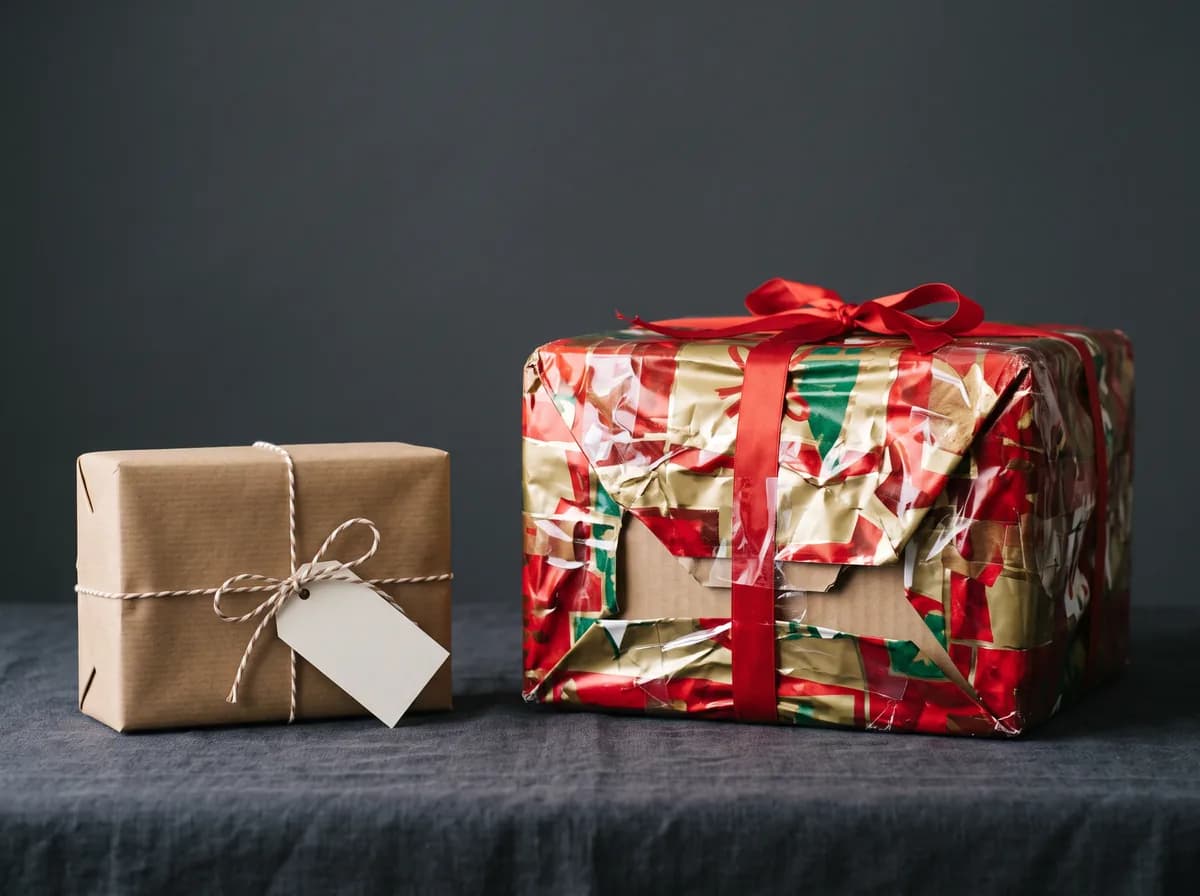
Coworkers' incomes can vary widely, so an office exchange is better kept around $5 to $10—see Secret Santa gifts for coworkers for more. You will find specific ideas at each price point under Secret Santa gifts.
How many people do you need?
The exchange technically works with three people. It gets good at five, and the sweet spot is six to twelve.
Honestly, secrecy does not hold up well with three or four people. Everyone can work out the assignments in a couple of steps. It can still be a lovely occasion—just do not expect much suspense.
Once the group grows beyond fifteen, shopping becomes harder to track and opening gifts drags on. Split into smaller groups or switch to a dice gift exchange, which keeps everyone involved at once.
Julklapp: where the tradition comes from
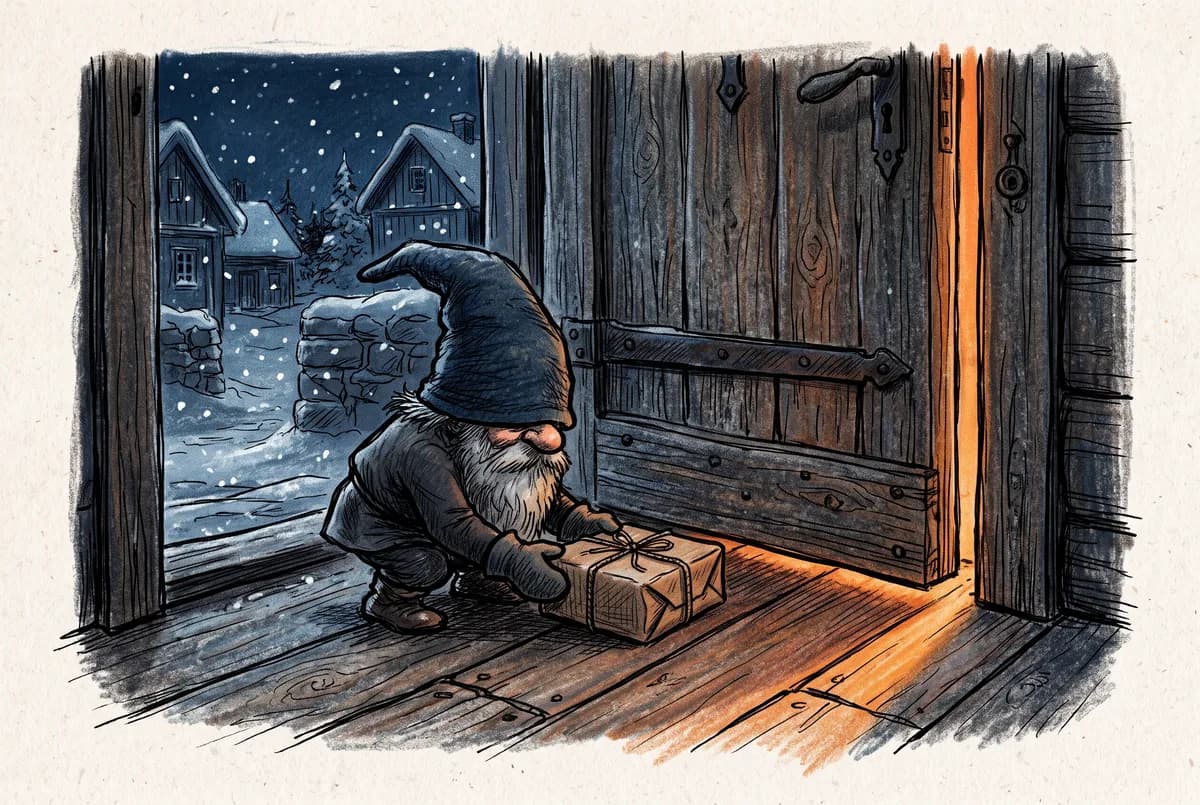
The custom originated in Sweden, where it is called Julklapp—literally “Christmas gift.” The same name is still used in northern Germany.
The elf figure is older than the gift exchange itself. In Nordic folklore, it is a small, humanlike being that lives out of sight in people's homes and quietly helps them. That is where the German name for the exchange comes from.
Originally, the gift was delivered just as secretly: it was slipped to its recipient sometime during Advent without revealing the giver. Only later did the exchange move to the holiday gathering, and the anonymous delivery become the name draw we know today.
Draw names now
Draw Secret Santa names in ten seconds—right in your browser, with no account or email addresses. The assignments form a closed loop: everyone gives to exactly one person, no one draws themselves, and there are no reciprocal pairs that would spoil the surprise for both people.
Frequently asked questions
Can someone draw themselves in Secret Santa?
Yes, when names are drawn from a hat—that is the most common mistake. You then have to reshuffle. A name-drawing tool prevents self-matches automatically.
How can I stop couples from drawing each other?
There is no reliable way with paper slips. A digital draw can specify who may not draw whom, which is useful for couples in family groups and coworkers on the same team.
How much do people usually spend on Secret Santa?
$5 to $20 is common, and $10 to $15 is the usual range. Classrooms often set a $5 maximum.
What if someone gets sick?
Redraw in a small group. In a larger group, ask someone to cover the now-unmatched recipient as well.
Do I have to participate?
No. Anyone who does not want to join should say so before the draw; otherwise, someone will be left without a gift in the exchange.
What age is old enough for kids to play Secret Santa?
Around age six, once a child can keep the secret for two weeks. An Advent-style exchange is easier for preschool groups.
What is the difference between Wichteln and Secret Santa?
There is none. Wichteln is the German name for the same tradition.
How is Secret Santa different from an elf door?
An elf door is a children's Advent tradition: an elf lives behind a tiny door and leaves letters and small pranks. It has nothing to do with a gift exchange.