
Elder Futhark · rune 22 of 24
Ingwaz ᛜ
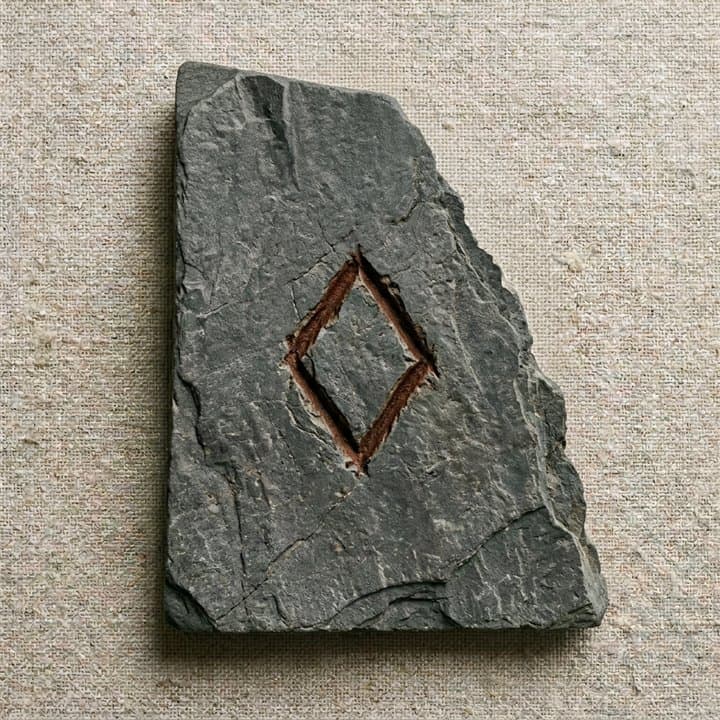
| Character | ᛜ (Unicode U+16DC) |
| Name | Ingwaz · Old English Ing · Old Norse Yngvi |
| Sound value | ng |
| Number | 22 of 24 |
| Aett | third |
| Reversal | no — axially symmetrical |
Contained potential · prepared release · a completed transition
The Old English rune poem says Ing was first seen among the East Danes, then departed eastward over the waves with his wagon following. The verse appears to remember a named ancestral or divine figure, not a seed, pregnancy, or generic “inner potential.” Those popular images are modern attempts to interpret the enclosed stave and the story of arrival and departure.
The name and its history
Ingwaz carries the name Ing, a Germanic divine or heroic figure often compared with Old Norse Yngvi and the fertility god Freyr. The relationships among these names and figures are complex; the rune poem does not provide a genealogy or a divination definition.
The sound value is the ng sound, as in the end of English sing. The displayed diamond-like form is one of the historical forms associated with the rune.
What the rune poems emphasize
Only the Old English poem preserves a verse. It says Ing was first seen among the East Danes, then went east over the sea, with his wagon following. The Heardingas named the hero in this way.
The wagon recalls documented descriptions of cult processions, but the exact event behind the verse is unknown. What the text clearly supplies is a sequence: arrival, presence, departure. A modern theme of completion or contained potential should remain secondary to that narrated movement.
The narrated departure also distinguishes completion from permanence. Something can have fulfilled a role and still need to leave. In a modern reading, identify what has actually been finished, what remains stored or unspoken, and who must be told that the phase has changed. Closure is a decision supported by completed obligations, not a prediction that every loose end will resolve itself.
Upright
Ingwaz points to something sufficiently gathered to change state: a plan ready to leave private preparation, an obligation ready to close, or energy that needs a defined release. Containment is useful when it protects formation; it becomes avoidance when no condition would ever feel ready.
What the rune says — and why there is only one position
The displayed Ingwaz form is axially symmetrical, so rotating it does not produce a visually distinct reversed position. The guide uses one position.
Completion can still be incomplete in practice: a phase may need closure, stored effort may need release, or departure may be delayed. Examine that stage directly instead of assigning it to a reversal the character cannot show.
Ingwaz in four areas of life
Love. A private feeling may be ready for respectful expression, but disclosure does not create an obligation in the other person.
Work. Move a prepared project into review with clear acceptance criteria and ownership for the next stage.
Money. Release funds only when the purpose, limit, and downside are defined. The rune does not promise return.
Well-being. Completion and transition may be useful themes; reproductive claims or diagnoses are not supported.
Neighboring runes
With Jera, completion meets harvest. The pair can mark a cycle whose work and result are ready to be acknowledged and closed.
With Berkano, an ending meets new growth. It is useful for transitions in which closure and beginning overlap.
As a daily rune
Complete one contained process today. Define the sign that preparation is sufficient, then release the next step.
Finish the draft, close the loop, or set the launch condition. Do not call indefinite secrecy “incubation.”
Frequently asked questions
Who is Ing in the rune poem?
The verse presents Ing as a figure associated with the East Danes who later departs over the sea. His precise historical identity remains debated.
Does the rune poem call Ingwaz a seed?
No. The poem narrates Ing’s presence and departure with a wagon. Seed and gestation are later symbolic associations, not words used in the verse.
Does Ingwaz mean pregnancy?
Not as a reliable historical or predictive claim. That association is modern and cannot establish pregnancy or fertility.
Can Ingwaz guarantee completion?
No. It can prompt you to define readiness and close a process, but it cannot guarantee the outcome.
Who is Ing in the Old English rune poem?
The poem treats Ing as a hero or divine figure seen among the East Danes who later travels east over the sea with his wagon following. His exact historical or mythic identity is not settled.
To reflect on
What is being protected by containment? What exact condition marks completion? What will carry the work after it leaves your control?
Explore all 24 rune meanings, compare the main runic alphabets, try a rune reading, or see how a name can be approximated in runes.
Editorial note: Rune reading is a modern reflective practice. This page separates linguistic and historical evidence from contemporary interpretation.