
Elder Futhark · rune 12 of 24
Jera ᛃ
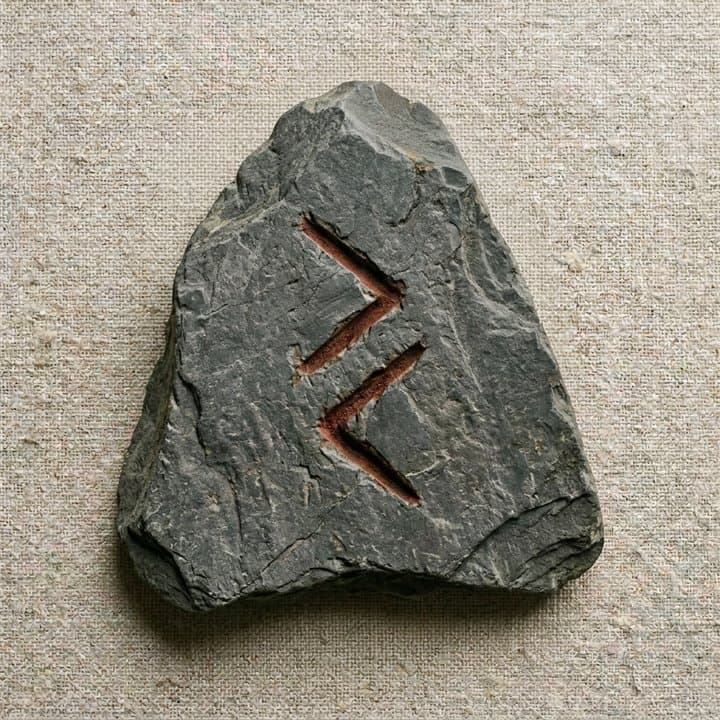
| Character | ᛃ (Unicode U+16C3) |
| Name | Jera · Old English ger · Old Norse ár |
| Sound value | j |
| Number | 12 of 24 |
| Aett | second |
| Reversal | no — axially symmetrical |
Season · harvest · return shaped by earlier work
Jera names the year and, more specifically in the poems, the good season or harvest. The Old English verse describes it as a source of hope when the ruler of heaven allows the earth to produce bright fruits for rich and poor. The Nordic poems likewise connect a good year with peace and plenty. The image is cyclical, agricultural, and conditional: seed, labor, weather, and time all precede the crop.
The name and its history
Reconstructed jēran means year and belongs to the same word family as English year. In the agricultural context preserved by Old Norse ár, it can also mean the yield or harvest that makes a year good.
The name therefore points beyond elapsed calendar time. It concerns what a completed season produces. Modern ideas of cycles and consequences fit best when they retain uncertainty about weather, labor, and whether the expected result actually arrives.
What the rune poems emphasize
The Old English poem calls harvest the hope of people, conditional on the earth producing bright fruit, and says its value extends to rich and poor. The Nordic tradition calls the harvest people’s gain and invokes the legendary peace and abundance associated with King Fróði.
These verses recognize dependence rather than an automatic reward. Work and waiting matter, yet no farmer controls every condition. Jera can frame timing and accumulated effects without becoming a promise that patience always earns a favorable outcome.
The evidence therefore favors a review of conditions and results over a moral claim that every outcome was deserved.
Upright
Jera points to results arriving in proportion to a completed cycle. It may be time to collect, evaluate, or recognize that patient work has crossed a threshold. The result is not necessarily a prize; a harvest also reveals what the season actually produced.
Respect timing without using it as an excuse. Some processes cannot be rushed, but they can still be tended, measured, and revised before the next cycle.
What the rune says — and why there is only one position
The displayed Jera sign is axially symmetrical. A half-turn produces the same arrangement, so the guide uses one position and does not attach a second meaning to an invisible reversal.
One position can still include an incomplete season, delayed results, a poor yield, or the need to finish what was started. Examine the stage of the cycle directly rather than assigning those possibilities to a reversed face.
Jera in four areas of life
Love. Look at patterns built over time rather than judging the relationship by one dramatic day. Repeated care creates the season.
Work. Review a completed phase and capture the lesson before launching the next. Recognition should follow actual contribution.
Money. Compare return with time, cost, and risk. Jera does not guarantee profit merely because you waited.
Well-being. Sustainable habits can be evaluated over an appropriate period, while medical outcomes require professional evidence.
Neighboring runes
With Isa, the yearly cycle meets ice. The pair can make a pause intelligible as a season within the process rather than proof that nothing will change.
With Hagalaz, harvest meets hail. A disruption may reduce the outcome without erasing every result of the longer cycle.
As a daily rune
Complete one small cycle today: finish, review, and record what the effort produced.
Close a task instead of adding another beginning. Note what you would plant differently next time.
Frequently asked questions
Is Jera the harvest rune?
Yes. The poem tradition links its name with the year, a good season, and the earth’s produce.
Does Jera guarantee a reward for waiting?
No. The poems describe harvest as hoped-for yield that still depends on the earth and other conditions. Time and labor do not guarantee a favorable result.
Does Jera promise a reward?
No. It frames timing and results, but cannot guarantee that effort produces the outcome you want.
Is Jera only about long-term plans?
No. Any complete cycle—a day’s work, a review period, or a finished conversation—can use the same pattern.
Does Jera mean “year” or “harvest”?
Both senses belong to the historical name tradition. The word can denote a year and the yield that makes it a good year, so the poems emphasize hoped-for produce rather than time alone.
To reflect on
What cycle is genuinely ready to close? What did you cultivate, and what arrived through conditions outside your control? Which lesson belongs in the next season?
Explore all 24 rune meanings, compare the main runic alphabets, try a rune reading, or see how a name can be approximated in runes.
Editorial note: Rune reading is a modern reflective practice. This page separates linguistic and historical evidence from contemporary interpretation.