
Elder Futhark · rune 11 of 24
Isa ᛁ
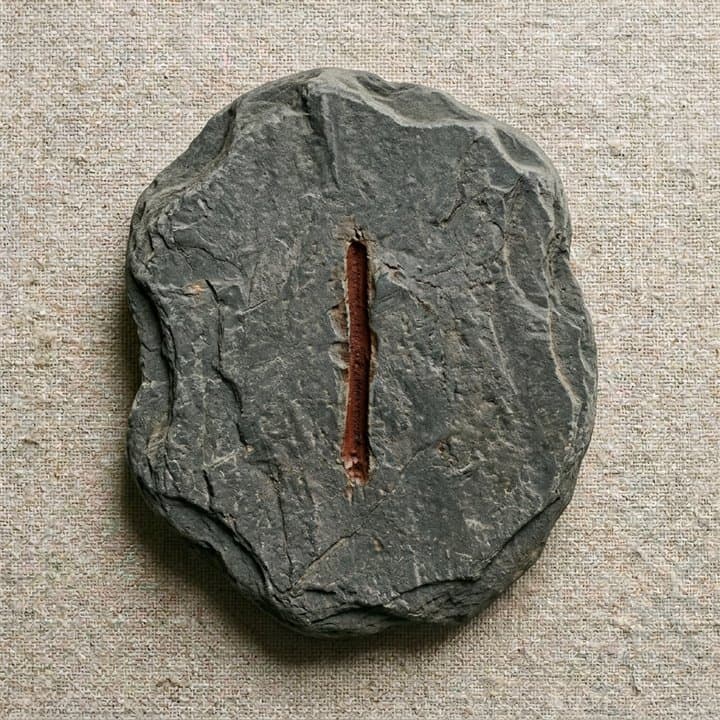
| Character | ᛁ (Unicode U+16C1) |
| Name | Isa · Old English is · Old Norse íss |
| Sound value | i |
| Number | 11 of 24 |
| Aett | second |
| Reversal | no — axially symmetrical |
Stillness · concentration · a surface that may not hold
The rune poems describe ice with both admiration and fear. Old English verse calls it extremely cold and slippery, bright like glass and beautiful like a floor made of frost. Nordic poems emphasize a broad bridge, a roof over waves, and danger to the doomed. Ice creates structure out of moving water, but that structure is temporary and treacherous.
The name and its history
Reconstructed īsaz means ice, as do Old English is and Old Norse íss. The name is direct and secure. The one-stroke form also makes Isa easy to overlook in an inscription or confuse with a divider when the surrounding context is unclear.
Its simplicity should not be mistaken for a universal ancient symbol of “stillness.” That concept is a modern abstraction from detailed poem images of frozen water, beauty, access, danger, and concealment.
What the rune poems emphasize
The poems praise ice before warning about it. The Old English verse calls it extremely cold, glass-clear, and jewel-like, then notes its slippery surface. The Norwegian poem calls ice a broad bridge but adds that a blind person needs guidance. The Icelandic poem names it river bark and a roof over waves, then associates it with danger.
Ice therefore carries weight while water continues beneath it. A modern reading can examine pause, preservation, and hidden movement without treating delay as either wholly safe or wholly negative.
The bridge image also explains why “do nothing” is too simple a gloss. Frozen water may permit a crossing that open water prevented, while introducing a different risk. In practical reflection, ask what the pause makes possible, what continues under the surface, and which warning signs would show that the temporary structure can no longer bear weight.
Upright
Isa points to pause, containment, and attention narrowed to one line. A temporary freeze can protect resources, stop escalation, or allow a decision to wait until conditions are clearer.
Stillness is not the same as safety. Ask whether the pause is deliberate and time-bounded or whether fear has made immobility feel permanent. Before crossing a glossy surface, test what supports it.
What the rune says — and why there is only one position
Isa is a vertical stroke and remains the same under a 180-degree turn. It is axially symmetrical, so there is no visually distinct reversed position in this guide.
The single position still holds tension: ice can preserve, support a crossing, hide a current, or create a dangerous surface. Decide which description fits the evidence in the situation instead of using orientation to choose automatically.
Isa in four areas of life
Love. A cooling-off period can prevent harm if both people know when and how the conversation will resume.
Work. Hold a change long enough to verify the evidence. Indefinite paralysis is not the same as careful review.
Money. A spending freeze may create useful clarity, but decisions still need current figures and obligations.
Well-being. Rest can matter; numbness or persistent symptoms need appropriate support. Isa is not a medical assessment.
Neighboring runes
With Nauthiz, stillness meets need. A real shortage may have to be managed while action is limited, making patience and conservation more useful than force.
With Jera, ice meets the yearly cycle. Winter belongs to the process; the pause may be seasonal rather than permanent.
As a daily rune
Pause one moving part today. Use the stillness to inspect what normally passes too quickly.
Set an end point for the pause. Silence a notification for an hour, delay a reactive reply, or freeze one variable while you test another.
Frequently asked questions
What does Isa mean historically?
Its rune-poem image is ice: cold, smooth, beautiful, and potentially dangerous.
Is Isa only a negative rune?
No. The poems describe ice as beautiful and capable of forming a bridge, while also stressing cold, slipperiness, concealment, and danger.
Does Isa always mean delay?
No. It can represent focus, containment, or a chosen pause as well as stagnation.
Can Isa predict that a situation will remain frozen?
No. Conditions change, just as ice does. Use the rune to set a review point, not to declare a fixed future.
Why do the rune poems compare ice with a bridge?
Frozen water could create a route across a river, but the poems also stress cold, slipperiness, and danger. The image combines temporary access with the need for care.
To reflect on
What benefits from staying still? What is hidden beneath the smooth surface? When will you test whether movement can safely resume?
Explore all 24 rune meanings, compare the main runic alphabets, try a rune reading, or see how a name can be approximated in runes.
Editorial note: Rune reading is a modern reflective practice. This page separates linguistic and historical evidence from contemporary interpretation.