
Elder Futhark · rune 10 of 24
Nauthiz ᚾ
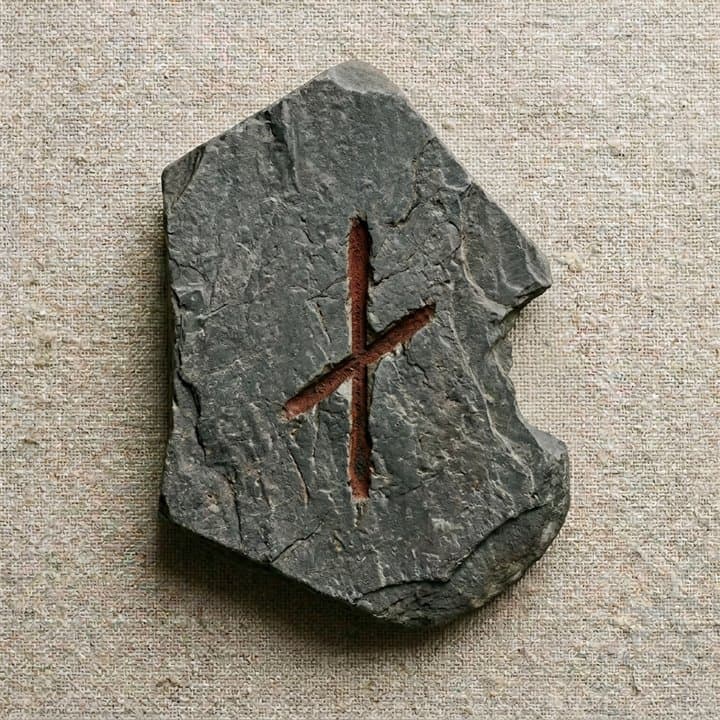
| Character | ᚾ (Unicode U+16BE) |
| Name | Nauthiz · Old English nyd · Old Norse nauð |
| Sound value | n |
| Number | 10 of 24 |
| Aett | second |
| Reversal | no — axially symmetrical |
Need · constraint · the work that cannot be skipped
The Old English rune poem calls need oppressive to the heart, then adds that it can become help if recognized in time. The Nordic poems are harsher: constraint leaves little choice and makes conditions difficult. The verses do not romanticize deprivation. They distinguish a real limit from the useful response it may demand.
The name and its history
Reconstructed naudiz means need, constraint, or distress. Old English nyd and Old Norse nauð preserve the same cluster of meanings. The word covers both a shortage—something is absent—and compulsion—something must be done.
That double sense matters more than a simple “hardship” keyword. A need can reveal a nonnegotiable condition, while pressure can also make people mistake urgency for wisdom.
What the rune poems emphasize
The Nordic poems state the harsh conditions plainly: need leaves little choice, the unclothed person freezes, and labor under constraint is difficult. The Old English poem adds that need can become help or healing when people listen to it in time. Attention, not suffering by itself, creates the possibility of a response.
The Eddic poem Sigrdrífumál also names a need-rune in poetic instructions for protecting a drink from deceit. That is evidence for a medieval literary idea, not proof of an effective ritual or a complete historical divination system.
A source-based reading also separates urgency from importance. The poems describe cold, labor, and constriction, all conditions that narrow choices. Before treating pressure as a command, identify the minimum requirement, the deadline supported by evidence, and the resource most likely to fail. That turns the rune’s historical language of need into a checkable modern prompt without praising deprivation.
Upright
Nauthiz asks what is genuinely necessary now. A shortage, duty, boundary, or dependency may narrow the available options. The constructive move is to name the constraint accurately and stop spending energy on choices that do not exist.
Necessity can sharpen priorities, but hardship is not automatically noble. Ask for help, reduce scope, and protect essentials. The rune supports deliberate response, not the claim that people “needed” whatever harm occurred.
What the rune says — and why there is only one position
The displayed Nauthiz sign is axially symmetrical. Rotating it 180 degrees leaves the same character, so this guide does not manufacture a separate reversed position.
Need already contains a range from useful constraint to damaging deprivation. Read that range through concrete facts: what is missing, what is compulsory, what can be addressed early, and which pressure cannot be solved by greater effort.
Nauthiz in four areas of life
Love. State a need without disguising it as an accusation. Another person may understand it without being able to meet it.
Work. Identify the hard constraint—time, staffing, information, or scope—and renegotiate the plan around it.
Money. Prioritize essential obligations and verify available assistance. The rune offers no guarantee that resources will appear.
Well-being. Basic needs and professional care take precedence over symbolic endurance. Do not use Nauthiz to justify ignoring pain or deprivation.
Neighboring runes
With Isa, need meets immobility. The pairing can describe a shortage that cannot be solved immediately and calls for conservation rather than pressure.
With Wunjo, need meets joy. Relief may be arriving, or a cheerful atmosphere may be concealing a material lack that still needs attention.
As a daily rune
Name the nonnegotiable need today. Meet it with the smallest sufficient action.
Separate “must,” “should,” and “would prefer.” Then complete or request one thing that protects the true must.
Frequently asked questions
Is Nauthiz only negative?
No. The poems acknowledge hardship, while the Old English verse also says recognized need can become a source of help.
Does Nauthiz mean need or compulsion?
Both senses belong to the historical word family. It can describe a shortage and the constraint or necessity produced by that shortage.
Does Nauthiz mean I must suffer?
No. It asks you to recognize constraints and seek an adequate response; it does not glorify preventable harm.
Can Nauthiz predict financial trouble?
No. It cannot forecast a shortage. Use current numbers, contracts, and qualified advice.
What constructive point appears in the Old English Nauthiz verse?
It says need can become help or healing when people heed it in time. The benefit comes from recognizing the constraint early, not from treating suffering as inherently good.
To reflect on
Which limit is a fact, and which one is an assumption? What help becomes available when you describe the need precisely? What can be postponed without harming the essential task?
Explore all 24 rune meanings, compare the main runic alphabets, try a rune reading, or see how a name can be approximated in runes.
Editorial note: Rune reading is a modern reflective practice. This page separates linguistic and historical evidence from contemporary interpretation.