
Elder Futhark · rune 13 of 24
Eihwaz ᛇ
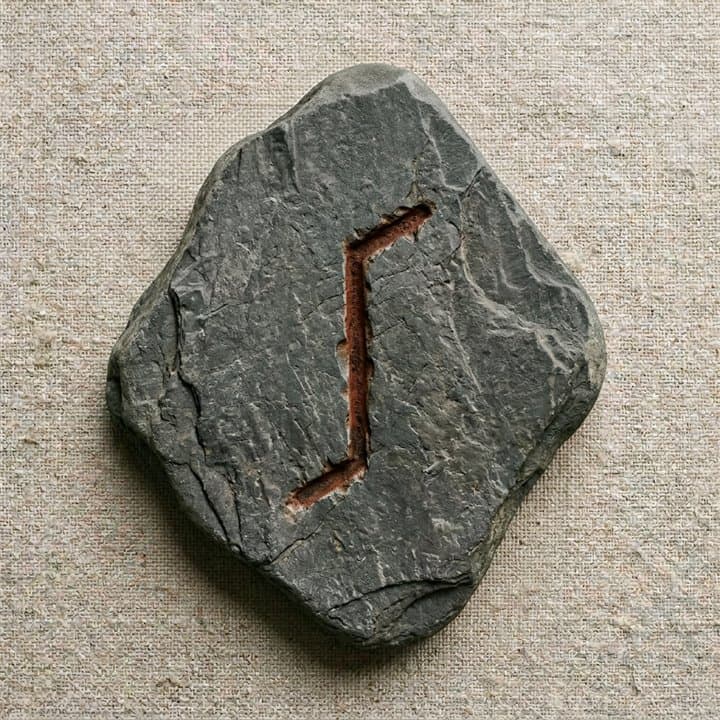
| Character | ᛇ (Unicode U+16C7) |
| Name | Eihwaz · Old English eoh |
| Sound value | uncertain; conventionally ï |
| Number | 13 of 24 |
| Aett | second |
| Reversal | no — point-symmetrical |
Endurance · flexible structure · continuity through change
Eihwaz is associated with the yew. The Old English poem describes a rough-barked tree, hard and firmly rooted, a guardian of flame and a joy on an estate. The yew’s durable wood and long life make resilience a reasonable modern theme, but claims that the rune historically meant death, rebirth, or a specific world tree go beyond what this verse establishes.
Its sound value is also difficult to carry into modern English with precision. Eihwaz belongs to an earlier linguistic system, not a one-to-one English spelling code.
The name and its history
Īhwaz or īwaz means yew and is related to English yew. The name has Celtic relatives as well, including Welsh ywen. Only the Old English rune poem preserves a verse for this character because it did not continue as a separate sign in the Younger Futhark.
Its sound value is genuinely uncertain. Scholarly proposals differ, and the conventional transliteration ï is a practical label rather than a recovered pronunciation. That uncertainty is especially important when using the rune to transcribe a modern name.
What the rune poems emphasize
The Old English poem calls the yew rough outside, hard and fast in the earth, supported by its roots, and a joy on an estate. It also calls the tree a guardian of fire. Dense yew wood can burn slowly and preserve embers, giving that phrase a practical setting.
The verse emphasizes endurance through material details rather than through an abstract doctrine of immortality. A modern reading about resilience should therefore ask what supports the situation, what preserves necessary heat, and whether holding fast remains useful.
Yew’s historical uses add another limit to the popular symbolism. Hard, elastic wood was valuable, but the poem itself does not turn the tree into a doctrine of death and rebirth. Keep those later associations labeled as modern. The attested verse supports questions about roots, durability, fuel, and belonging more directly than claims about an initiatory gateway.
Upright
Eihwaz points to resilience built into structure: deep roots, material that bends without immediately breaking, or a plan designed to survive transition. It favors continuity that can adapt rather than rigidity praised for its own sake.
Ask what holds the system together and whether that support remains healthy. Endurance may require changing method, shedding a role, or reinforcing a neglected connection.
What the rune says — and why there is only one position
Eihwaz is point-symmetrical: rotating the displayed sign 180 degrees produces the same character. There is no distinct reversed face, so this guide uses one position.
That does not make the reading automatically favorable. Rootedness can become immobility, preservation can consume resources, and endurance can outlast its purpose. Those tensions belong in the one visible position.
Eihwaz in four areas of life
Love. Durable connection includes room for both people to change. Ask which shared practice provides support without becoming control.
Work. Reduce dependence on one person or one fragile process. Resilience often looks like documentation and redundancy.
Money. Examine long-term durability, diversification, and access to reserves. The rune cannot certify an investment.
Well-being. Support and adaptation may matter during change, but health decisions require professional assessment rather than symbolic claims.
Neighboring runes
With Isa, endurance meets stillness. The pair asks whether something is being faithfully maintained or merely prevented from moving.
With Jera, the slow-growing yew meets a completed season. The combination favors long horizons and results that cannot be hurried.
As a daily rune
Strengthen one support that must outlast today. Make it flexible enough to survive change.
Repair a backup, document knowledge, practice a stabilizing skill, or check the root assumption beneath a plan.
Frequently asked questions
Is Eihwaz the yew rune?
Yes. The Old English poem explicitly describes the yew and its hard, rooted qualities.
Does the Eihwaz poem describe death and rebirth?
No. The surviving verse describes a rough, rooted yew that guards fire and is valued on an estate. Death-and-rebirth language belongs to modern interpretation.
Does Eihwaz historically mean death and rebirth?
Not as a direct statement from the surviving poem. Those are later interpretive associations and should be labeled as such.
Can Eihwaz guarantee protection?
No. It may prompt structural thinking, but a symbol cannot provide physical, legal, or financial protection.
Do scholars know the exact sound of Eihwaz?
No. Its historical sound value remains disputed, and the common transliteration ï is a convention. Any modern-name transcription using it should state that uncertainty.
To reflect on
What must remain continuous, and what form is allowed to change? Which root is genuinely supportive? Where has endurance become an excuse not to redesign a failing structure?
Explore all 24 rune meanings, compare the main runic alphabets, try a rune reading, or see how a name can be approximated in runes.
Editorial note: Rune reading is a modern reflective practice. This page separates linguistic and historical evidence from contemporary interpretation.