
Elder Futhark · rune 19 of 24
Ehwaz ᛖ
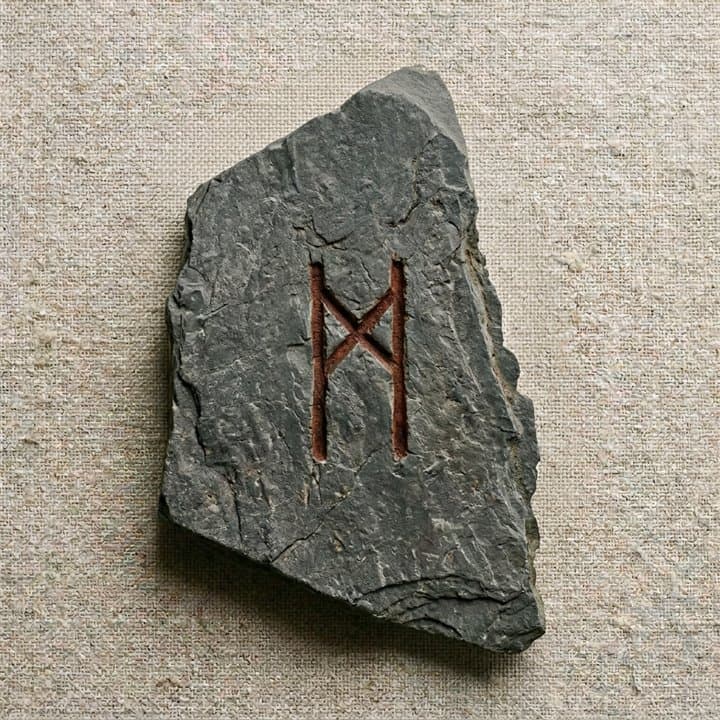
| Character | ᛖ (Unicode U+16D6) |
| Name | Ehwaz · Old English eh |
| Sound value | e |
| Number | 19 of 24 |
| Aett | third |
| Reversal | yes |
Partnership · pace · movement built on responsiveness
Ehwaz names the horse. The Old English poem praises it as a joy to nobles, a proud animal with firm hooves, and a source of comfort to the restless. A horse-and-rider image supports partnership only when the needs of both bodies, the rider’s skill, and the conditions of the route are respected. It is not merely a faster version of Raidho: Raidho emphasizes the journey and route; Ehwaz emphasizes coordinated movement.
That coordination must be renewed as conditions change. A partnership that worked on level ground may need a different pace, signal, or division of effort on difficult terrain.
The name and its history
Ehwaz means horse. Its word family is exceptionally old and includes Latin equus, Sanskrit aśva, and Old Irish ech. The Gothic letter name eyz is also associated with the horse.
The surviving evidence does not define the rune as a mystical bond. It begins with a valuable animal whose movement depends on training, care, and cooperation. Modern partnership readings are strongest when they preserve those practical conditions.
What the rune poems emphasize
Only the Old English poem preserves an Ehwaz verse. It calls the horse a joy to princes, proud in its hooves, and a subject wealthy riders discuss. The horse is therefore both a partner in movement and a shared object of attention, comparison, and status among people.
The verse ends by calling the horse a comfort to the restless. That gives the relationship an emotional dimension without dissolving the animal into a symbol. In a modern reading, ask what cooperation makes movement possible and whether both partners’ capacities and conditions are respected.
A horse is not merely transportation: it is a living partner with limits, care requirements, training, and agency of its own. That makes Ehwaz suitable for examining coordination, but not for predicting that another person will cooperate. State the shared destination, the contribution expected from each side, the signals used to adjust pace, and the condition under which either participant should stop.
The status language in the poem deserves attention too. Princes and wealthy riders can admire a horse while someone else performs much of its daily care. In a work or relationship reading, do not romanticize the visible partnership and overlook support labor. Identify who maintains the conditions that let the impressive movement happen.
Upright
Upright Ehwaz points to trust expressed through timing and response. Two people, systems, or capabilities may work well because each adjusts to the other. Progress depends on signals being clear and the pace being sustainable.
Reversed
Reversed Ehwaz can frame mismatched speed, broken trust, poor signaling, or a partnership in which one party carries all the weight. Reversal is modern. Slow down long enough to determine whether repair, retraining, or separation is the responsible step.
Ehwaz in four areas of life
Love. Trust appears in responsiveness, not surveillance. Check whether both people can influence the pace.
Work. Clarify interfaces and handoffs. A strong individual contribution can still fail inside a poorly coordinated system.
Money. Review shared obligations and incentives before treating a financial partnership as aligned.
Well-being. Pacing and support may matter, but changes to activity or treatment need appropriate professional input.
Neighboring runes
With Raidho, the horse meets the road. Ehwaz brings the partnership or vehicle; Raidho brings the route and its practical demands.
With Mannaz, partnership meets community. The pair can place a working relationship inside the larger group affected by it.
As a daily rune
Coordinate one move today. Confirm the signal, the pace, and who is carrying the load.
Ask before assuming readiness. A clean handoff is a better test than enthusiastic language about teamwork.
Frequently asked questions
Is Ehwaz the horse rune?
Yes. The Old English poem explicitly describes a valued horse.
How is Ehwaz different from Raidho?
Raidho centers on route and ordered travel. Ehwaz centers on the responsive partnership that makes movement possible.
What does reversed Ehwaz mean?
It can highlight mistrust, uneven load, or incompatible pace. Reversal is modern.
Can Ehwaz predict a move or trip?
No. It cannot forecast relocation or travel. Use real plans and evidence.
What does the Old English Ehwaz poem say about horses?
It describes a proud horse as a joy and topic of conversation among riders, then calls it a comfort to the restless. The verse combines movement, status, relationship, and solace.
To reflect on
What signal tells you the partnership is working? Who is adapting most? Would changing pace solve the problem, or is the direction itself disputed?
Explore all 24 rune meanings, compare the main runic alphabets, try a rune reading, or see how a name can be approximated in runes.
Editorial note: Rune reading is a modern reflective practice. This page separates linguistic and historical evidence from contemporary interpretation.