
Elder Futhark · rune 20 of 24
Mannaz ᛗ
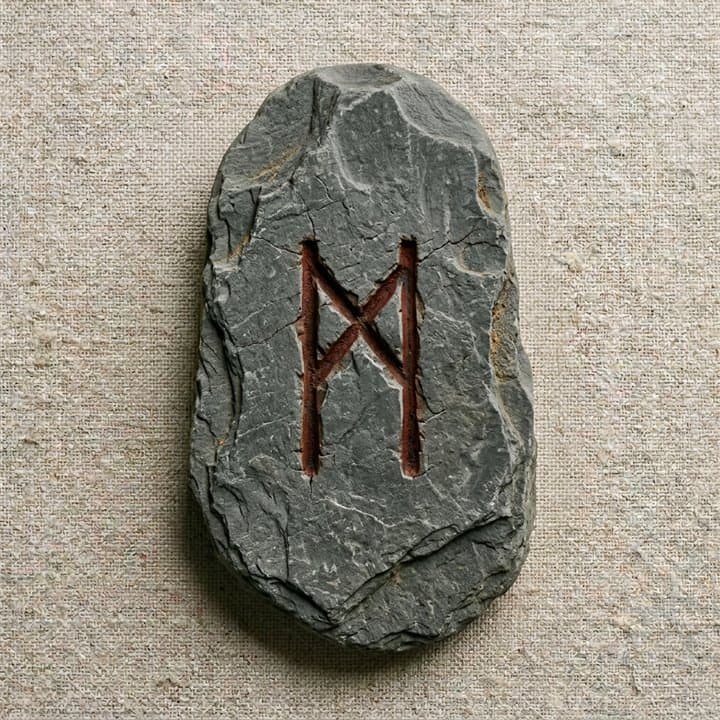
| Character | ᛗ (Unicode U+16D7) |
| Name | Mannaz · Old English man · Old Norse maðr |
| Sound value | m |
| Number | 20 of 24 |
| Aett | third |
| Reversal | yes |
Human perspective · mutual dependence · the self among others
Mannaz means the human being or humanity. The Old English poem says a person is dear to kin yet must eventually depart because the body returns to earth. Nordic poems stress human dependence, social life, and mortality. The source is neither simple self-celebration nor an invitation to worship “the higher self.” It places a person inside kinship, limits, and time.
The name and its history
Mannaz means a human being, not specifically a modern English “man.” Old English man and Old Norse maðr could refer to a person or humanity; narrower gendered usage developed later.
Tacitus names Mannus as an ancestral figure of Germanic peoples in Germania. The resemblance to the rune name is notable, but the sources do not establish that the rune depicts or invokes that figure. It is better treated as an open etymological connection than a settled identity.
What the rune poems emphasize
The Icelandic poem says that a person is another person’s joy, then calls humanity an increase of dust: community and mortality in the same verse. The Norwegian poem also invokes the return to earth. The Old English verse says people are dear to their kin yet must eventually leave one another because the body is entrusted to the ground.
The source tradition makes interdependence finite rather than sentimental. Mannaz can prompt attention to roles, support, accountability, and loss. In group questions, identify who holds power and who does the labor.
The poems also resist the idea that self-sufficiency is the highest form of strength. Kinship, companionship, and work link people, while mortality guarantees that every arrangement changes. In a modern prompt, list the people affected by a choice, the knowledge each holds, and the obligations no one has named. Community becomes concrete when authority, labor, benefit, and risk are visible.
Mortality also places a limit on postponement. The poems do not say that every relationship must be preserved at any cost; they say that human presence is valuable and temporary. A useful response may be gratitude, repair, succession planning, or a clear ending. Choose it from the actual relationship rather than from a generalized duty to belong.
Upright
Upright Mannaz asks how human perspective shapes the situation. Cooperation, empathy, and self-awareness may be resources, while bias and limited knowledge remain part of the same condition. Seek another viewpoint without surrendering responsibility for your own choice.
Reversed
Reversed Mannaz can frame isolation, projection, group pressure, or an identity defended so rigidly that feedback becomes impossible. Reversal is modern. Check whether you are treating a personal interpretation as a fact about everyone else.
Mannaz in four areas of life
Love. Notice the person in front of you rather than the role you assigned them. Mutual understanding still allows difference.
Work. Examine team norms, incentives, and blind spots. “Culture” should not hide who holds power and who does the labor.
Money. Social comparison can distort decisions. Use your actual needs, obligations, and reliable advice.
Well-being. Connection may support health, but shame and isolation deserve real support rather than symbolic judgment.
Neighboring runes
With Ehwaz, community meets partnership. The pair examines a close working bond inside the wider network that supports or constrains it.
With Isa, human connection meets ice. Communication or trust may have frozen, and progress may require someone to make a deliberate first move.
As a daily rune
Test one assumption about another person today. Ask, listen, and revise your model if the answer differs.
Choose a low-risk assumption and a direct, respectful question. Do not demand private information merely to settle your uncertainty.
Frequently asked questions
Does Mannaz mean humanity?
Yes. The poem tradition centers on human beings, kinship, dependence, and mortality.
What does reversed Mannaz mean?
It can highlight alienation, projection, or pressure to conform. The reversal is modern.
Is Mannaz only about the self?
No. Its historical material places the individual within human relationships and finite life.
Can Mannaz reveal another person’s thoughts?
No. It cannot access private motives. Ask the person and respect their boundaries.
Does Mannaz mean “man” or “human”?
The historical words could mean a person or humanity, not only an adult male. “Human” is the clearer modern gloss for the breadth of the rune name.
To reflect on
Which part of the interpretation comes from your own position? Whose perspective is absent? What responsibility remains yours even after you understand the group?
Explore all 24 rune meanings, compare the main runic alphabets, try a rune reading, or see how a name can be approximated in runes.
Editorial note: Rune reading is a modern reflective practice. This page separates linguistic and historical evidence from contemporary interpretation.