
Elder Futhark · rune 5 of 24
Raidho ᚱ
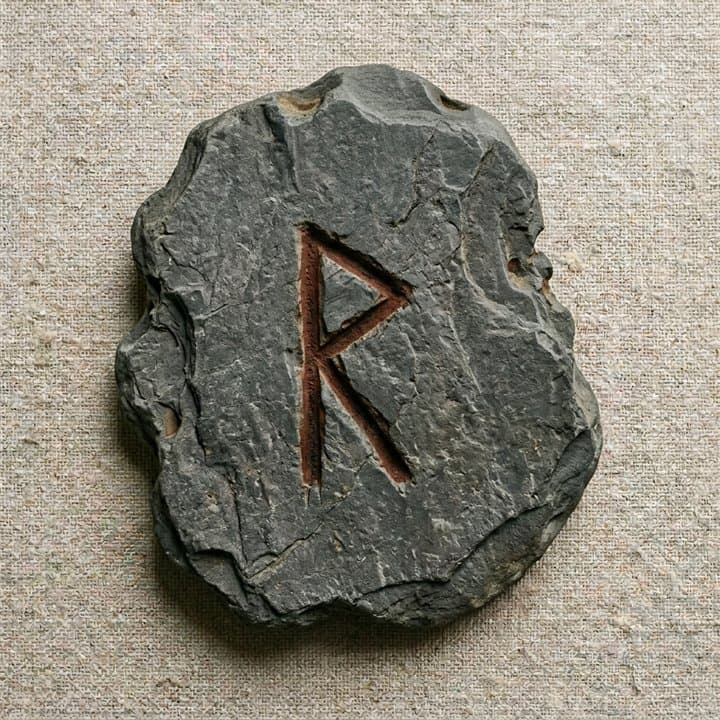
| Character | ᚱ (Unicode U+16B1) |
| Name | Raidho · Old English rad · Old Norse reið |
| Sound value | r |
| Number | 5 of 24 |
| Aett | first |
| Reversal | yes |
Journey · sequence · movement with a route
Raidho is the riding rune. The Old English poem makes a sharp joke out of perspective: riding seems easy to a warrior sitting safely indoors, but it is hard work for someone on a powerful horse traveling a long road. The Norwegian and Icelandic poems likewise connect riding with effort, speed, and a horse’s labor. The source is not simply “travel is good.” It asks who is moving, over what ground, and at what cost.
Modern readings extend that practical image to schedules, procedures, and any process in which order matters. Raidho is less about escape than about coordinating direction, pace, and companions.
The name and its history
Reconstructed raidō means a ride, journey, or vehicle. Its relatives include Old English rad and Old Norse reið, as well as English road and ride. The name therefore begins with actual movement rather than a generalized spiritual “path.”
The character closely resembles Latin R, and its form is often discussed among the likely borrowings or adaptations from an alphabet used south of the early Germanic-speaking world. That possible history concerns the sign’s shape, not a divinatory meaning.
What the rune poems emphasize
The Old English poem observes that riding seems easy to a warrior sitting indoors; the person covering miles on a strong horse knows otherwise. The Norwegian poem shifts the burden to the horse. The Icelandic verse calls riding the seated person’s blessing and the horse’s hardship.
Two of the traditions therefore distinguish the traveler’s plan from the labor that carries it. That makes Raidho more than a promise of progress. In a modern reading it can ask who chose the route, who bears its cost, and whether the arrangement can survive the distance.
Upright
Upright Raidho points to movement that has a workable sequence. A trip has a route, a meeting has an agenda, or a change has a next step that can be named. Progress comes from respecting timing rather than demanding instant arrival.
Check who is carrying the load. A plan can look smooth from the seat of the person giving instructions while being punishing for the person doing the travel. Good direction includes realistic time, resources, and consent from the people moving with you.
Reversed
Reversed Raidho can show a disrupted route, bad timing, incompatible pace, or motion used to avoid the actual destination. It may be a missed connection, but it may also be a plan whose assumptions no longer match the terrain.
Reversal is modern. Before calling the delay a sign, check logistics, instructions, and dependencies. A detour can be useful information without becoming destiny.
Raidho in four areas of life
Love. Ask whether you are moving in the same direction and at a pace both people can sustain. Shared plans need more than implied agreement.
Work. Map the handoff, deadline, and decision owner. A stalled process often needs a clearer sequence rather than greater urgency.
Money. Review the path from income to expense and the timing of commitments. The rune does not guarantee that a financial journey ends well.
Well-being. Routine and pacing may deserve attention. Use professional guidance for health decisions, especially before changing treatment or activity.
Neighboring runes
With Ehwaz, the journey meets the horse. Raidho supplies the route; Ehwaz brings attention to the partner, vehicle, or working relationship that makes movement possible.
With Ansuz, movement meets speech. The pair can point to news traveling, a conversation in another place, or an agreement that needs clear directions.
As a daily rune
Choose the next waypoint, not the whole horizon. Check the route before you accelerate.
Put one step in the calendar, confirm what it depends on, and leave enough margin for the road to be harder than it looked indoors.
Frequently asked questions
Does Raidho mean travel?
Yes, riding and journeying are central to the poem tradition, but the verses also emphasize effort, distance, and perspective.
What does reversed Raidho mean?
It can frame delay, poor coordination, a wrong turn, or movement without a useful destination. The reversal is modern.
Does Raidho promise a safe trip?
No. It cannot predict travel conditions or safety. Check real routes, weather, rules, and professional advice where needed.
Can Raidho refer to a process rather than a trip?
Yes. Modern readings often use its sequence-and-direction theme for routines, projects, and transitions.
What do the rune poems say about riding?
They contrast the rider’s experience with the horse’s labor. The Old English poem says a journey looks easy from indoors, while the Nordic poems stress the burden borne by the horse.
To reflect on
What is the next verifiable waypoint? Who bears the effort of your plan? If the route changed today, which part of the destination would still matter?
Explore all 24 rune meanings, compare the main runic alphabets, try a rune reading, or see how a name can be approximated in runes.
Editorial note: Rune reading is a modern reflective practice. This page separates linguistic and historical evidence from contemporary interpretation.