
Elder Futhark · rune 4 of 24
Ansuz ᚨ
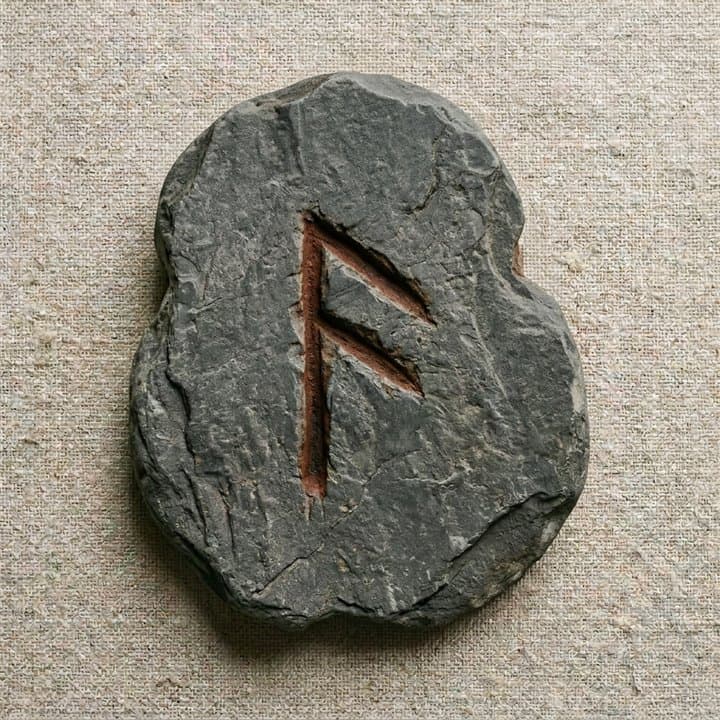
| Character | ᚨ (Unicode U+16A8) |
| Name | Ansuz · Old English ōs · Old Norse óss |
| Sound value | a |
| Number | 4 of 24 |
| Aett | first |
| Reversal | yes |
Speech · listening · meaning carried between people
Ansuz is commonly introduced as “Odin’s rune,” but the later rune poems preserve more than one association. The Old English poem names the mouth and praises it as the source of language, wisdom, and comfort. The Icelandic poem connects its rune name with an ancestral god and ruler of Valhalla. The Norwegian tradition uses a form associated with an estuary. These are related through language history, but they should not be flattened into a single quotation from antiquity.
For a modern reading, the strongest common thread is transmission: a word leaves one place, passes through a channel, and reaches another person—or fails to.
The name and its history
The reconstructed name ansuz means “god” and is related to Old Norse áss, plural æsir. That explains the frequent label “Odin rune,” but the label compresses several traditions. Odin’s discovery of the runes in the Eddic poem Hávamál concerns runes collectively, not this character alone.
The Gothic letter-name evidence is uncertain, and some scholars have proposed a word for an ear of grain instead. The safest description keeps the divine etymology while acknowledging that the medieval rune names developed in different directions.
What the rune poems emphasize
The Old English poem interprets ōs as a mouth: the source of speech, support of wisdom, and comfort of the wise. The Norwegian poem uses óss for a river mouth, the route of journeys. Only the Icelandic poem names a god unmistakably, calling him the old Gaut and prince of Asgard—titles of Odin.
These are not interchangeable translations. They do share an image of passage: speech passes through a mouth, vessels through an estuary, and knowledge through the figure of Odin. A modern reading about communication should remain anchored in that varied evidence rather than claiming one fixed ancient oracle meaning.
Upright
Upright Ansuz favors clear speech, attentive listening, and information that can be checked. It may point to a useful explanation, a teacher, a difficult truth stated well, or the moment when a vague idea finally acquires words.
Do not confuse eloquence with accuracy. The practical task is to identify the speaker, the evidence, and the listener. If the message matters, repeat back what you understood and record the decision rather than trusting everyone to remember the same conversation.
Reversed
Reversed Ansuz can frame crossed messages, persuasive nonsense, selective listening, or words used to avoid action. It may also reflect inhibition: knowing what needs to be said while continually postponing it.
Because reversal is a modern convention, use it as a communication audit. What was actually said? What was inferred? Which claim has a source, and which part is rumor or projection?
Ansuz in four areas of life
Love. Replace mind-reading with a direct question. Listening counts only if the answer is allowed to change your interpretation.
Work. Clarify ownership, definitions, and the next decision. A polished presentation cannot repair missing evidence.
Money. Read the terms, ask what a fee or promise means, and keep a record. Ansuz does not turn a sales pitch into reliable advice.
Well-being. Describe symptoms and concerns accurately when seeking care. The rune may help organize a question, but it cannot answer a medical one.
Neighboring runes
With Raidho, speech meets a route. The pair can frame a message in transit, a conversation tied to travel, or words that need a practical path.
With Kenaz, speech meets illumination. Saying something clearly may make a previously hidden issue visible.
As a daily rune
Make one important message easier to understand today, and confirm what the other person heard.
Choose a real email, request, briefing, or conversation. Remove one ambiguity and ask one sincere follow-up question.
Frequently asked questions
Is Ansuz always the rune of Odin?
No. The Icelandic tradition supports a divine association, while the Old English poem centers on the mouth and the Norwegian name developed differently.
What does upright Ansuz mean?
It points to communication, learning, and meaning transmitted clearly enough to be checked.
What does reversed Ansuz mean?
It can highlight misinformation, ambiguity, unspoken words, or listening shaped by expectation. That reversal is modern.
Can Ansuz reveal a hidden message?
No. It cannot authenticate a rumor or disclose private thoughts. Check the source and ask the person involved.
Why is Ansuz often called Odin’s rune?
Its reconstructed name means “god,” and the Icelandic rune poem uses titles of Odin. The Old English and Norwegian poems instead describe a mouth and a river mouth, so the association is not the whole record.
To reflect on
What do you know because someone said it, and what can you verify independently? Which conversation are you rehearsing instead of having? Write the message in one sentence, then write the question that would test whether it landed.
Explore all 24 rune meanings, compare the main runic alphabets, try a rune reading, or see how a name can be approximated in runes.
Editorial note: Rune reading is a modern reflective practice. This page separates linguistic and historical evidence from contemporary interpretation.