
Elder Futhark · rune 3 of 24
Thurisaz ᚦ
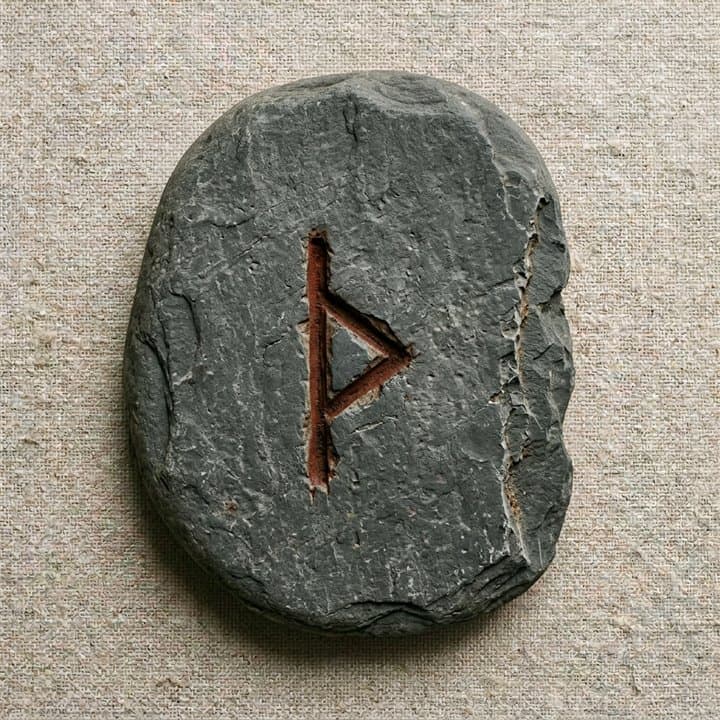
| Character | ᚦ (Unicode U+16A6) |
| Name | Thurisaz · Old Norse þurs · Old English þorn |
| Sound value | th, as in thing |
| Number | 3 of 24 |
| Aett | first |
| Reversal | yes |
Boundary · warning · force with consequences
The rune ᚦ carries the sound heard at the start of thorn. Its names also reveal a split in the poem tradition. The Old English poem describes the thorn itself: painfully sharp to anyone who grabs it and unpleasant to rest among. The Norwegian and Icelandic poems instead speak of the thurs, a giant or hostile being, and stress harm and danger. Thorn and giant are not the same object, but both make carelessness costly.
Modern readers often call Thurisaz a protection rune. That can be useful if protection means a visible boundary and an informed response. It becomes misleading when the sign is sold as an automatic shield. The poems describe danger more readily than magical safety.
The name and its history
Þurisaz is the reconstructed name behind Old Norse þurs, a giant or hostile being. Old English uses þorn, “thorn,” instead. No source explains why that naming tradition shifted from a mythic adversary to a sharp plant, so both forms belong in an honest account.
The character also survived beyond runic inscriptions. The letter thorn, þ, carried the same sound into Old English writing and remains part of the modern Icelandic alphabet. Its ordinary use as a letter is separate from later symbolic interpretations.
What the rune poems emphasize
None of the three rune-poem traditions makes this sign gentle. The Old English poem calls the thorn extremely sharp and painful to anyone who touches or lies near it. The Norwegian and Icelandic poems retain the giant and describe distress, misfortune, and a cliff-dwelling being.
The Old English image makes a useful distinction: the thorn does not pursue anyone. Its danger lies in contact and distance. That supports a modern reflection on boundaries more securely than claims that the rune guarantees supernatural protection. The sign is also attested early, including on the Thorsberg chape from around 200 CE.
Upright
Upright Thurisaz asks you to recognize the point at which contact has consequences. That may be a deadline, a refusal, a security weakness, or a conversation that needs a pause before it becomes an attack. Its strength is alertness followed by proportionate action.
The rune does not require aggression. A thorn protects the plant by making a boundary costly to cross; it does not chase anyone. In a reading, distinguish defense from retaliation and a necessary warning from the pleasure of sounding threatening.
Reversed
Reversed Thurisaz can frame reactivity, a warning ignored, or defensive force turned inward. You may be braced for an attack that is not happening, or moving too quickly because pressure feels like proof. It can also point to a boundary that exists only in words and has never been enforced.
This is a modern reversal convention, not a second historical poem. Check the facts before naming an enemy, and choose the smallest action that genuinely reduces harm.
Thurisaz in four areas of life
Love. Say what is unacceptable without turning the relationship into a contest. If fear is driving the reading, verify what happened before assigning motives.
Work. A risk, access rule, or scope limit may need attention. Document it and use the appropriate escalation path instead of relying on intimidation.
Money. Treat the rune as a reminder to inspect downside, fraud exposure, and contractual limits—not as proof that a loss is coming.
Well-being. Stress can make every signal feel dangerous. Use the prompt to notice safety and boundaries, while taking medical concerns to a professional.
Neighboring runes
With Algiz, Thurisaz compares two defensive images. Algiz suggests watchful resistance; Thurisaz emphasizes the sharp consequence of crossing a boundary.
With Uruz, an obstacle meets raw force. The pair can indicate enough power for a confrontation while warning that force alone rarely provides finesse.
As a daily rune
Identify one real boundary today. State it clearly, then leave room for a measured response.
Write down what the boundary protects, what behavior crosses it, and what you will actually do if that happens. A specific boundary is more useful than generalized suspicion.
Frequently asked questions
Does Thurisaz literally mean thorn?
In the Old English poem, the corresponding rune is thorn. The Nordic poems use a related name for a thurs or giant, so both traditions matter.
Is Thurisaz an ancient protection charm?
Not on the evidence of the rune poems alone. Modern practice often uses it protectively, but the historical verses emphasize painful or hostile force.
What does reversed Thurisaz mean?
It can highlight overreaction, ignored warnings, or a defensive posture that creates its own harm. The reversal is modern.
Can Thurisaz predict an attack?
No. A rune cannot establish another person’s plans or predict violence. Use concrete safety information and appropriate help.
Is the letter thorn related to Thurisaz?
Yes. The runic character developed into the letter thorn, þ, for the th sound. It was used in Old English and remains in modern Icelandic.
To reflect on
What are you protecting, and from what observable behavior? Is your response proportionate to the risk? What would a firm boundary look like if it did not depend on anger?
Explore all 24 rune meanings, compare the main runic alphabets, try a rune reading, or see how a name can be approximated in runes.
Editorial note: Rune reading is a modern reflective practice. This page separates linguistic and historical evidence from contemporary interpretation.