
Elder Futhark · rune 15 of 24
Algiz ᛉ
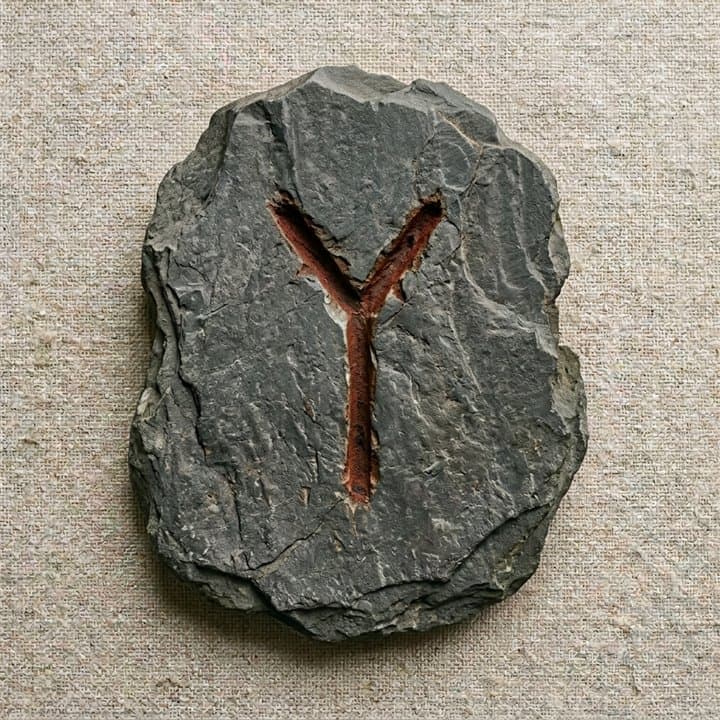
| Character | ᛉ (Unicode U+16C9) |
| Name | Algiz (also Elhaz) · Old English eolhx |
| Sound value | z; an older voiced s-like sound |
| Number | 15 of 24 |
| Aett | second |
| Reversal | yes |
Alertness · protective limits · contact that carries risk
The familiar name Algiz is a scholarly reconstruction and its original meaning is disputed. The Old English rune poem instead names eolh-secg, usually understood as an elk-sedge or marsh plant. It grows in wet ground, wounds anyone who grabs it, and stains with blood. The verse provides an image of passive defense: the plant does not promise safety; it makes careless contact costly.
Modern “protection rune” language should therefore remain practical. A drawn symbol cannot replace locks, training, consent, safety equipment, or expert advice.
The name and its history
Algiz and Elhaz are modern conventional names for a rune whose historical reconstruction is difficult. The Old English poem calls it eolhx-secg, probably a kind of sedge rather than simply an elk. The character’s older sound value was a voiced s-like sound conventionally written z and did not normally begin words.
Wilhelm Grimm proposed an elk connection in 1821, but the linguistic path remains disputed. The marsh-plant reading fits the poem’s concrete description and keeps protection grounded in a cutting boundary rather than an animal emblem.
What the rune poems emphasize
The Old English verse places the sedge in a marsh, growing in water. It wounds and draws blood from anyone who touches it, probably evoking saw-edged Cladium mariscus. The image is defensive without being passive: the plant remains where it is and contact has a cost.
No matching verse survives in the Nordic rune poems because the sign changed function and name in the Younger Futhark. Modern readings of vigilance and boundaries can grow from the English image, but claims of an ancient universal “protection rune” go beyond the evidence.
Upright
Upright Algiz points to alertness and a boundary that is visible before it is crossed. It may call for protective preparation, a clear refusal, or awareness of an environment in which small mistakes have consequences.
Effective protection is specific. Name the risk, the safeguard, the person responsible, and the point at which help is needed. Vague vigilance easily becomes anxiety.
Reversed
Reversed Algiz can frame hypervigilance, a failed safeguard, or openness without adequate boundaries. It may also expose a “protective” action that controls someone else instead of reducing a real risk.
This reversal is modern. Verify the threat and use proportionate measures rather than treating fear itself as evidence.
Algiz in four areas of life
Love. Safety includes consent, privacy, and room to say no. Protection is not ownership.
Work. Review access, escalation, and physical or digital safeguards. Document the control instead of relying on a symbol.
Money. Check fraud defenses, account permissions, and contractual exposure. Algiz cannot insure a transaction.
Well-being. Use evidence-based precautions and qualified care. Persistent fear may itself deserve support.
Algiz, the Life Rune, and extremist use
Guido von List included a recast version of this shape in the 18-character Armanen rune row he created in 1902. In that modern system, the upright form became the “Man Rune” or “Life Rune,” while the rotated form became the “death rune.” Those labels do not come from the rune poems or the historical Elder Futhark record.
Nazi organizations later used the Life Rune, including the SS-run Lebensborn program. The Anti-Defamation League’s Life Rune entry documents its Nazi and later white supremacist use; the United States Holocaust Memorial Museum preserves a Lebensborn brochure bearing a red Life Rune.
The ADL also notes that non-racist people, particularly some neo-pagans, still use the same shape, so it advises judging the symbol in context rather than treating every Algiz as extremist. The inverted-looking form also existed separately as the yr rune in Younger Futhark, an ordinary letter; calling it a “death rune” is a 20th-century addition. For a tattoo or public display, check the entire design and its likely audience, and use the rune tattoo guide as a starting point. This is historical and social context, not legal advice.
Neighboring runes
With Nauthiz, protection meets scarcity. The pair can show a narrow situation in which clear limits preserve the resources that remain.
With Gebo, a boundary meets an exchange. Ask whether giving is reciprocal, voluntary, and safe, especially when one person contributes more.
As a daily rune
Check one real safeguard today. Make the boundary clear enough that others can respect it.
Update a password, confirm an emergency contact, state a limit, or inspect the equipment that actually carries the risk.
Frequently asked questions
Does Algiz mean elk?
The reconstructed name is debated. The Old English poem refers to a sharp marsh plant commonly translated as elk-sedge.
Is Algiz historically a protection rune?
The poem’s plant wounds anyone who grasps it, which supports defensive imagery. Claims of a universal ancient protection charm go further than the source.
What does reversed Algiz mean?
It can highlight overexposure, a weak safeguard, or fear that has become controlling. Reversal is modern.
Can Algiz protect me from harm?
No. A symbol cannot provide physical or legal protection. Use appropriate real-world safeguards.
Is Algiz a Nazi symbol?
The historical rune is much older than Nazism and is not automatically extremist. Nazis used the shape as the “Life Rune,” and later white supremacists adopted it, so assess the complete context, orientation, accompanying symbols, and stated use.
To reflect on
What specific risk are you addressing? Which safeguard is active rather than decorative? At what point would alertness become counterproductive vigilance?
Explore all 24 rune meanings, compare the main runic alphabets, try a rune reading, or see how a name can be approximated in runes.
Editorial note: Rune reading is a modern reflective practice. This page separates linguistic and historical evidence from contemporary interpretation.