
Elder Futhark · rune 7 of 24
Gebo ᚷ
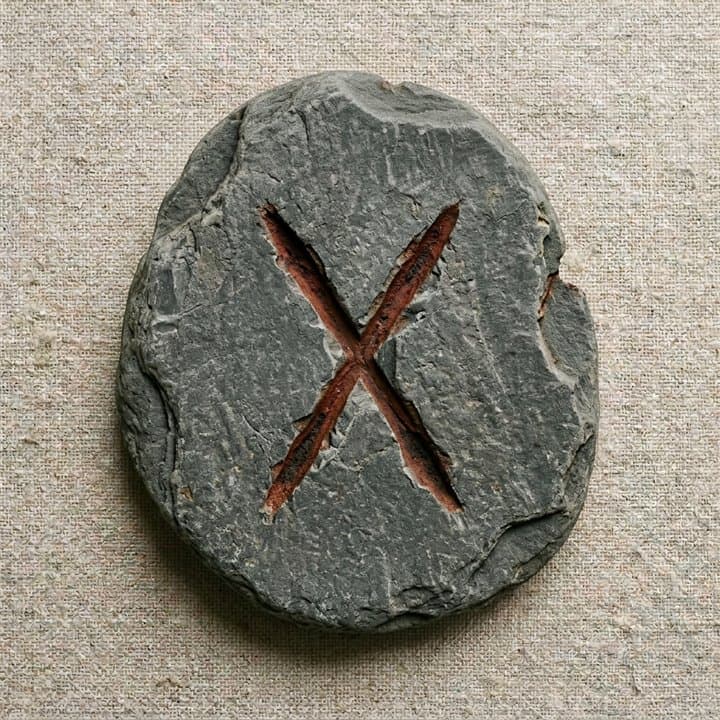
| Character | ᚷ (Unicode U+16B7) |
| Name | Gebo · Old English gyfu |
| Sound value | g |
| Number | 7 of 24 |
| Aett | first |
| Reversal | no — the sign is symmetrical |
Gift · reciprocity · obligation
Gebo looks like an X: two strokes meet and cross. That shape makes an intuitive modern symbol of partnership, but the rune’s older name points first to a gift. In societies where gifts established loyalty, rank, and mutual obligation, giving was rarely a casual act with no consequences.
The distinction matters because modern guides often call Gebo a “love rune.” It can be used to think about a relationship, but the surviving source speaks more broadly about generosity, honor, and support. Gebo is less about finding a destined partner than about understanding what passes between people.
Gebo is also symmetrical. Turn the sign upside down and it remains the same. The tool therefore gives it no reversed position; imbalance must be read from the question, its assigned place, and the runes around it.
The gift that creates a relationship
The reconstructed name gebō means gift. Its relatives include Old English gyfu, modern English give, and German geben. A gift in an early Germanic social setting could create a durable relationship: a ruler rewarded a follower, a guest received hospitality, or two parties confirmed an alliance. Acceptance brought expectations as well as benefit.
That history keeps Gebo from becoming a generic symbol of niceness. A useful reading asks what is being exchanged, whether the terms are understood, and what obligation follows. A gift can express care, but it can also create leverage or an unspoken debt.
The surviving poem
Gebo disappeared from the 16-character Younger Futhark, so it has no matching stanza in the Norwegian or Icelandic rune poems. The Old English rune poem preserves the relevant verse. In paraphrase, it says generosity brings honor and dignity, while providing support and sustenance to someone who otherwise has nothing.
The emphasis is social rather than romantic. Giving affects the standing of the giver and the life of the recipient. Reading Gebo as partnership is a reasonable modern extension of reciprocity and its crossing form, but it is not a meaning stated by an ancient divination manual.
What the rune says
Gebo draws attention to an exchange: help, trust, labor, a promise, a contract, a favor, or a material gift. Ask what each side gives, what each side receives, and whether the expectations have been spoken aloud.
The rune can support cooperation when both parties retain agency and understand the terms. It can also expose a relationship in which generosity is being used to control, impress, or avoid a direct request. Because there is no reversed position, a difficult reading does not require an invented “reversed Gebo.” The tension appears in the real circumstances and in neighboring signs.
Gebo in four areas of life
Love. Look at reciprocity rather than asking whether another person is destined for you. Are affection, attention, compromise, and practical care moving both ways without a hidden scorecard?
Work. Gebo can frame collaboration, mentorship, a contract, or help offered at the right moment. Clarify what each person is responsible for before goodwill turns into an unspoken obligation.
Money. Gifts, loans, shared expenses, and inherited resources all create relationships. Check whether repayment, ownership, and expectations are explicit; the rune does not replace financial or legal advice.
Well-being. Notice whether generosity is sustainable. Support can strengthen connection, but giving beyond your capacity may leave both sides dependent on a pattern that cannot last.
Neighboring runes
With Fehu, the gift meets movable wealth. This pair can focus on whether resources are circulating freely or whether generosity is being used to purchase loyalty.
With Algiz, exchange meets protection and boundaries. The combination asks whether you can remain generous without giving away your safety, privacy, or ability to choose.
As a daily rune
Notice what moves between you and someone else today—and whether both sides understand the exchange.
Before offering or accepting help, state the practical expectation in one sentence. In the evening, check whether anything important was assumed but never said.
Frequently asked questions
What does Gebo mean?
Gebo means gift. Its historical and modern associations include generosity, exchange, reciprocity, and the obligations that relationships can create.
Is Gebo a love rune?
That is a common modern interpretation, not the wording of the surviving poem. Gebo can be useful for reflecting on partnership because its core theme is exchange, but it does not promise romance or identify a soulmate.
Can Gebo be reversed?
No. Gebo is symmetrical in the form used here, so turning it 180 degrees does not create a distinct position. Read difficulty through context and neighboring runes rather than inventing a reversed meaning.
Why is Gebo missing from the Norwegian and Icelandic rune poems?
Those poems describe the 16-character Younger Futhark. Gebo belongs to the older 24-character row and was among the signs removed when the alphabet changed.
Can Gebo predict the future?
No. Gebo cannot tell you what another person will do. It can help you examine the evidence for reciprocity, obligation, and consent in an exchange that is already taking place.
To reflect on
What are you giving, what do you expect in return, and which part of that expectation has not been said aloud?
Explore all 24 rune meanings, compare the main runic alphabets, try a rune reading, or see how a name can be approximated in runes.
Editorial note: Historical evidence and modern reflective use are presented separately. Gebo’s modern relationship symbolism should not be mistaken for an attested ancient divination rule.