
Elder Futhark · rune 1 of 24
Fehu ᚠ
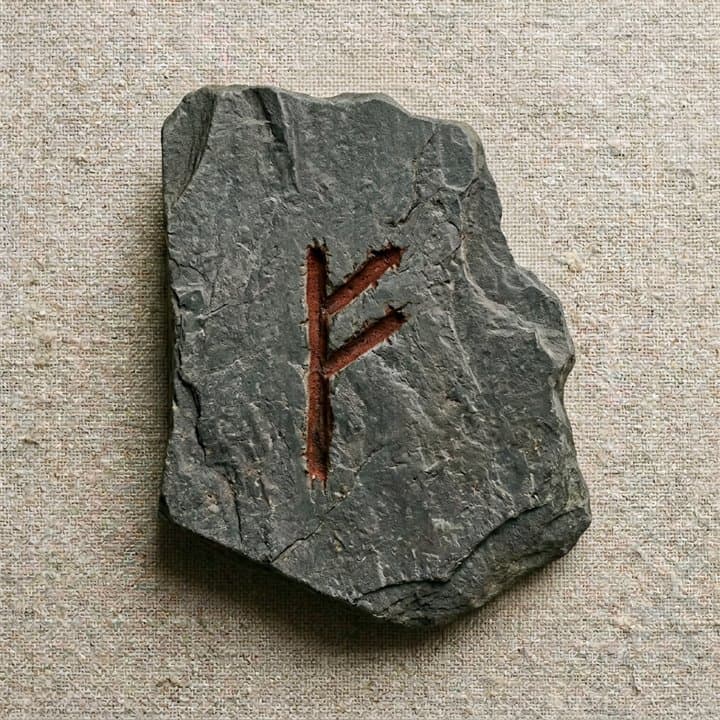
| Character | ᚠ (Unicode U+16A0) |
| Name | Fehu · Old English feoh · Old Norse fé |
| Sound value | f |
| Number | 1 of 24 |
| Aett | first (first rune) |
| Reversal | yes |
Movable wealth · circulation · responsibility
Fehu opens the Elder Futhark. Its name means cattle, which made it a practical image of wealth: valuable, countable, and capable of walking away. That last detail matters. Fehu is not primarily about owning land or inheriting a home; Othala is closer to that territory. Fehu concerns resources that can move—money, goods, time, skill, and support.
Modern rune guides often reduce Fehu to “prosperity.” The surviving poems offer a less comfortable picture. They connect wealth with generosity, obligation, and conflict among relatives. Fehu therefore asks a sharper question than “Will I become rich?” It asks what you have, how it moves, and what happens when it stops moving.
You can encounter Fehu in the rune reading as an upright or reversed sign. Those positional meanings are a modern reflective practice, not a reconstructed ancient divination system.
The name and its history
The reconstructed Proto-Germanic name fehu means cattle. Related words survive in German Vieh, Dutch vee, Old English feoh, and Old Norse fé. English fee belongs to the same word family. Across these forms, the idea moves from livestock toward payment and property, but it retains the sense of something with exchange value.
This makes Fehu a useful contrast with Othala. Fehu is portable wealth: livestock, money, stock, tools, or any resource that can circulate. Othala points more toward inherited land, home, and what is held across generations. The distinction is historical before it becomes symbolic.
What the rune poems emphasize
The three medieval rune-poem traditions are later than the earliest Elder Futhark inscriptions, so they do not give us a single ancient handbook of meanings. They do, however, preserve how related rune names were understood in different Germanic languages.
In paraphrase, the Old English poem calls wealth a comfort but says that anyone who wants honor should share it freely. The Norwegian poem links wealth with conflict among relatives. The Icelandic poem likewise begins with strife among kin. None of these sources guarantees a windfall. Together they place responsibility and social consequences beside possession.
That source pattern supports a restrained modern reading: Fehu can draw attention to available resources, but it also asks whether fear, hoarding, debt, or unequal exchange is distorting the situation.
Upright
Upright Fehu points to something usable. It may be money, but it can just as easily be time, access, a practical skill, a promising contract, or help that is genuinely available. The first task is to identify the resource in concrete terms rather than turning the rune into a vague promise of abundance.
Because Fehu begins the row, it can also mark an opening: the first workable step, an offer, or the point at which an idea gains material support. A favorable reading still requires action. Ask what can move now, what should be saved, and what needs to be shared.
Reversed
A reversed Fehu can frame blocked circulation or conflict over resources. Look for unpaid effort, a loan that changed a relationship, an inheritance dispute, neglected maintenance, or a possession that now limits your choices. The issue is not automatically poverty or bad luck. More often, it is friction around value and responsibility.
Reversal is a modern convention. The surviving rune poems do not provide separate verses for reversed signs. Use this position as a change of emphasis—a prompt to examine loss, withholding, or imbalance—not as historical fact or a prediction of misfortune.
Fehu in four areas of life
Love. Fehu asks how time, care, and practical support move between people. If either person is silently keeping score, name the imbalance instead of treating affection like an unpaid debt.
Work. Take stock of the resources you can actually use: time, budget, skills, authority, and support. An opportunity matters only if those pieces can move with it.
Money. This is Fehu’s most direct area. Check cash flow, reserves, obligations, and the fear of losing what you have. The rune is not financial advice and does not promise a gain.
Well-being. Treat energy and attention as limited resources. Notice what replenishes them, what drains them, and which boundary would protect enough capacity for the next step. Fehu does not diagnose health conditions.
Neighboring runes
With Othala, Fehu places movable resources beside inherited property or family legacy. The pair can highlight a transfer, an estate, or a disagreement about what should remain and what should circulate.
With Gebo, possession meets the gift. That pairing brings the Old English poem’s central tension into focus: resources can create standing and connection when they are shared, but every exchange also creates expectations.
As a daily rune
You have something usable today. Decide what should move and what should be protected.
Choose one resource you can name—a block of time, an amount of money, a skill, or an offer. By evening, check whether you used it deliberately or held on to it out of habit.
Frequently asked questions
What does Fehu mean?
Fehu means cattle and, by extension, movable wealth. In a modern reading it can point to resources, exchange, and the responsibility that comes with possession.
Is Fehu the rune for money?
It is the closest of the 24 Elder Futhark runes to money and portable wealth, but it does not promise profit. The rune-poem tradition is as concerned with generosity and conflict as it is with possession.
Can Fehu predict the future?
No. Fehu cannot predict a specific event or financial result. You can use it to examine which resources are present, how they are moving, and which decision remains under your control.
Why is Fehu first in the Futhark?
“Futhark” is formed from the first six rune sounds: f, u, th, a, r, and k. The order is attested in early inscriptions, including the Kylver Stone, but the reason this sequence was chosen is unknown.
Does Fehu need to be activated or charged?
No historical source requires a rune to be charged before it can be written or used as a reflective prompt. Ritual activation belongs to modern practice and should be labeled that way.
To reflect on
What resource are you treating as scarce even though some of it is available? What would responsible circulation look like, and what evidence would tell you that the exchange is fair?
Explore all 24 rune meanings, compare the main runic alphabets, try a rune reading, or see how a name can be approximated in runes.
Editorial note: Rune reading is a modern reflective practice. This page separates linguistic and historical evidence from contemporary interpretation.