
Elder Futhark · rune 6 of 24
Kenaz ᚲ
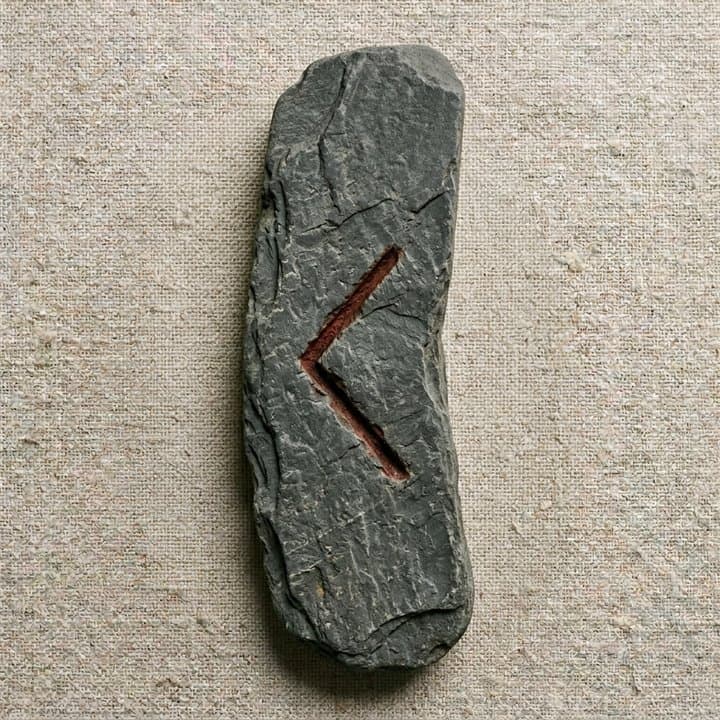
| Character | ᚲ (Unicode U+16B2) |
| Name | Kenaz · Old English cen · Old Norse kaun |
| Sound value | k |
| Number | 6 of 24 |
| Aett | first |
| Reversal | yes |
Made light · learned skill · what becomes visible
Kenaz contains one of the clearest disagreements among the rune poems. The Old English poem describes a torch known by its bright flame, burning where nobles sit indoors. The Norwegian and Icelandic poems use the related rune name for an ulcer or sore and describe pain and disease. Calling Kenaz simply “the torch rune” selects one branch of the evidence and leaves the other unmentioned.
The modern association with knowledge and craft comes most naturally from the controlled indoor flame: light made by people, in a particular place, for a purpose. The Nordic evidence adds a useful caution. Illumination can expose damage; not everything revealed is comfortable.
The name and its history
The familiar name Kenaz follows Old English cen, a resinous torch or pine splint used for light. The reconstructed Germanic name kauną instead fits Old Norse kaun, “sore” or “ulcer.” Both naming traditions are transmitted; presenting the rune as historically “the torch” erases the Nordic evidence.
Modern writers generally prefer the brighter image, which is understandable but editorial. The older sources require the uncomfortable bodily meaning to remain visible beside illumination.
What the rune poems emphasize
The Old English poem describes a torch known by its bright flame, burning where people rest indoors. The Norwegian and Icelandic poems describe a sore as a danger to children, a mark of disease, and a house of decaying flesh. In a world without modern treatment, infection was a concrete threat rather than an abstract shadow.
Both images concern something becoming visible. Fire reveals a room; a lesion reveals that something is wrong in the body. A careful modern interpretation can use insight or disclosure as a bridge between them without pretending that the poems taught one shared esoteric doctrine.
Upright
Upright Kenaz points to understanding created through attention and skill. A problem becomes visible enough to work on, a craft improves through practice, or someone explains the missing step. This is a lamp, not daylight: the field of view is useful but limited.
Name what the light actually reaches. Expertise in one area does not confer authority everywhere, and a compelling insight still needs evidence. The best action is often to demonstrate, test, revise, or teach one specific thing.
Reversed
Reversed Kenaz can frame partial knowledge, a skill neglected, or a revelation that exposes an uncomfortable flaw. It may also warn that certainty has outrun the available light.
This reversed reading is modern. Do not turn the Nordic ulcer imagery into a medical prediction. If the question concerns health, use the rune only to organize observations for qualified care.
Kenaz in four areas of life
Love. A frank conversation may illuminate a pattern, but insight should lead to changed behavior rather than another clever explanation.
Work. Develop or share a concrete skill. If the brief is unclear, make the unknown visible before promising delivery.
Money. Examine the numbers and the mechanism behind an offer. Kenaz supports scrutiny, not a guarantee of gain.
Well-being. Notice what information is missing and seek reliable assessment. A symbolic “sore” is not a diagnosis.
Neighboring runes
With Ansuz, light meets speech. The pair favors naming what has become visible and checking whether the explanation clarifies rather than merely dazzles.
With Isa, fire meets ice. Recognition may arrive while the situation remains immobile, separating the fact that you can see a problem from the ability to change it.
As a daily rune
Put a small light on one unclear problem today. Test what you learn before expanding the claim.
Choose a bounded task: inspect the document, practice the technique, ask for a demonstration, or verify one assumption.
Frequently asked questions
Is Kenaz the torch rune?
The Old English poem describes a torch. The Norwegian and Icelandic poems refer to an ulcer, so “torch” is important but not the entire record.
What does upright Kenaz mean?
It can represent cultivated skill, focused understanding, and a problem made visible enough to address.
What does reversed Kenaz mean?
It can highlight incomplete knowledge, neglected ability, or an unwelcome disclosure. Reversal is a modern convention.
Can Kenaz diagnose illness?
No. The Nordic poem’s ulcer image is historical language, not a diagnostic method.
Does Kenaz mean a torch or a sore?
Both meanings are preserved in different rune-poem traditions. Old English cen is a torch; the related Nordic name kaun means a sore or ulcer.
To reflect on
What has become clearer, and what remains outside the light? Which skill would let you act on the insight? What result would show that your explanation is wrong?
Explore all 24 rune meanings, compare the main runic alphabets, try a rune reading, or see how a name can be approximated in runes.
Editorial note: Rune reading is a modern reflective practice. This page separates linguistic and historical evidence from contemporary interpretation.