
Elder Futhark · rune 17 of 24
Tiwaz ᛏ
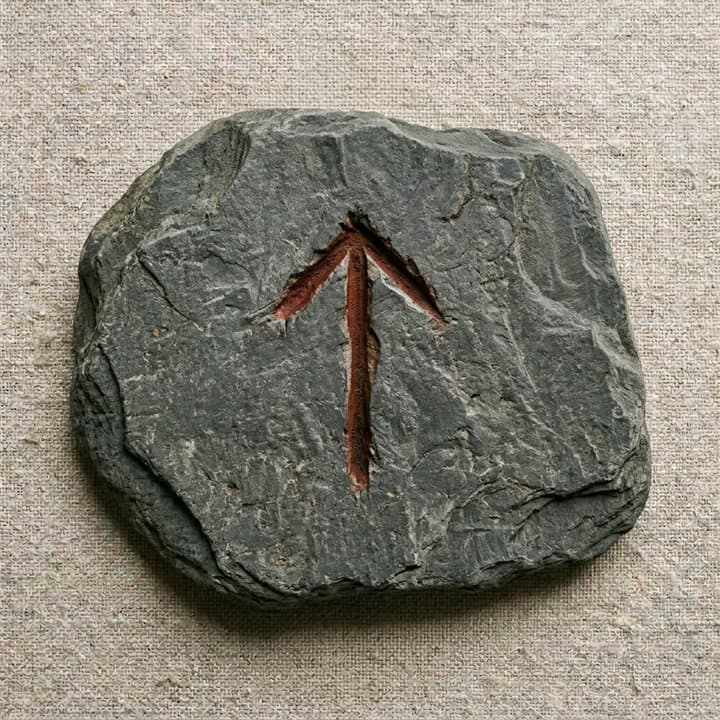
| Character | ᛏ (Unicode U+16CF) |
| Name | Tiwaz · Old Norse Týr · Old English tir |
| Sound value | t |
| Number | 17 of 24 |
| Aett | third (first rune) |
| Reversal | yes |
Commitment · fair process · a standard that costs something
Tiwaz carries the name of Tyr, a Germanic god associated in later Norse material with law and the binding of Fenrir. The Old English poem describes the corresponding sign as a dependable marker that keeps its course through the night. The sources support orientation and divine naming; a complete modern doctrine of victory or self-sacrifice is an interpretation, not a recovered manual.
The name and its history
Tīwaz is the older name of the god Týr and belongs to the Indo-European word family that includes Greek Zeus and Vedic Dyaus. The god’s name survives in English Tuesday, the day corresponding to Týr.
Historical relationships among gods and names are not a ready-made ethical code. Modern associations with justice and sacrifice usually draw on the myth in which Týr loses a hand when the gods bind the wolf Fenrir; they should be identified as interpretation, not a translation of the rune name.
What the rune poems emphasize
The Old English poem turns tir into a reliable celestial sign that travels above the night clouds and never fails the noble person. The Nordic poems name the one-handed god and allude to the wolf that took his hand. Both lines of tradition emphasize reliability under pressure.
The Eddic poem Sigrdrífumál poetically advises carving “victory runes” on a sword and naming Týr twice. This is rare literary evidence connecting a named rune or god with a stated use, but it remains poetry rather than proof of an effective technique.
The star and the god also prevent a shallow equation of Tiwaz with “winning.” The English image is valuable because it stays reliable, while the Fenrir story matters because Týr accepts a known cost for a collective agreement. Neither source says that a principled person always prevails. A careful reading asks which standard is being upheld, who accepts the risk, whether consent is present, and what evidence would justify the sacrifice.
A second check concerns proportionality. The story of Týr is memorable because the cost is irreversible, not because every cause deserves such a cost. Before using sacrifice as the theme, ask whether the goal is shared, whether less harmful options were considered, and whether the person accepting the loss also had a voice in the decision.
Upright
Upright Tiwaz asks whether a commitment follows a defensible standard. It may favor clear rules, accountability, or accepting a real cost because the principle matters. Fairness includes procedure: who was heard, what evidence counted, and whether the same rule would apply to you.
Reversed
Reversed Tiwaz can frame selective principles, an unfair contest, sacrifice demanded from the wrong person, or determination that has become rigidity. Reversal is modern; use it to audit the rule and the distribution of cost.
Tiwaz in four areas of life
Love. Fairness is not keeping score; it is making agreements explicit and allowing both people a voice.
Work. Use transparent criteria, documented responsibility, and an appeal path where consequences matter.
Money. Review obligations and conflicts of interest. Tiwaz cannot determine that a contract is lawful or fair.
Well-being. Discipline may support a plan, but punishment and overtraining are not evidence of virtue.
Neighboring runes
With Algiz, principle meets a boundary. The pair asks whether a limit can be explained and defended rather than merely asserted.
With Sowilo, decision meets clarity. Better orientation makes commitment possible, while responsibility for the choice remains with the reader.
As a daily rune
Choose one standard you are willing to apply consistently today, including to yourself.
Record the decision and the evidence behind it. If the rule changes when the outcome becomes inconvenient, examine why.
Frequently asked questions
Is Tiwaz Tyr’s rune?
Its name is connected with Tyr/Tiw. Later mythology and the Old English poem provide different parts of the historical picture.
What does reversed Tiwaz mean?
It can highlight unfairness, rigid judgment, or commitment serving pride rather than principle. Reversal is modern.
Does Tiwaz guarantee victory?
No. It can focus attention on standards and resolve, but it cannot guarantee an outcome.
Can Tiwaz decide a legal question?
No. Legal rights and strategy require current law and qualified advice.
Is Tuesday named after Týr?
Yes. Old English Tīwesdæg means Týr’s day, created as a Germanic counterpart to the Roman day of Mars. The connection preserves the god’s name, not a divination instruction.
To reflect on
What principle guides the decision? Who bears its cost? Would you defend the same process if it produced the opposite result?
Explore all 24 rune meanings, compare the main runic alphabets, try a rune reading, or see how a name can be approximated in runes.
Editorial note: Rune reading is a modern reflective practice. This page separates linguistic and historical evidence from contemporary interpretation.